Hundreds of Hospitals May Close or Cut Services


Nearly 450 hospitals across the United States are at risk of closing or cutting services due to Medicaid cuts, according to a report by the nonprofit consumer advocacy group Public Citizen. The hospitals served a total of 6.6 million people in 2024. These closures may particularly affect people who make a lower income and/or travel long distances for care.
The findings come nearly a year after Congress passed the One Big Beautiful Bill Act, which reduces Medicaid spending by $911 billion over 10 years and eliminates federal tax credits for the Affordable Care Act (ACA) health coverage. Medicaid provides nearly 67 million Americans with health insurance and helped pay for one-fifth of all hospital care in 2023, according to the nonprofit KFF. Without this money, 8.6 million people could lose their health insurance and hospitals that are already struggling financially may need to cut staff and reduce critical services.
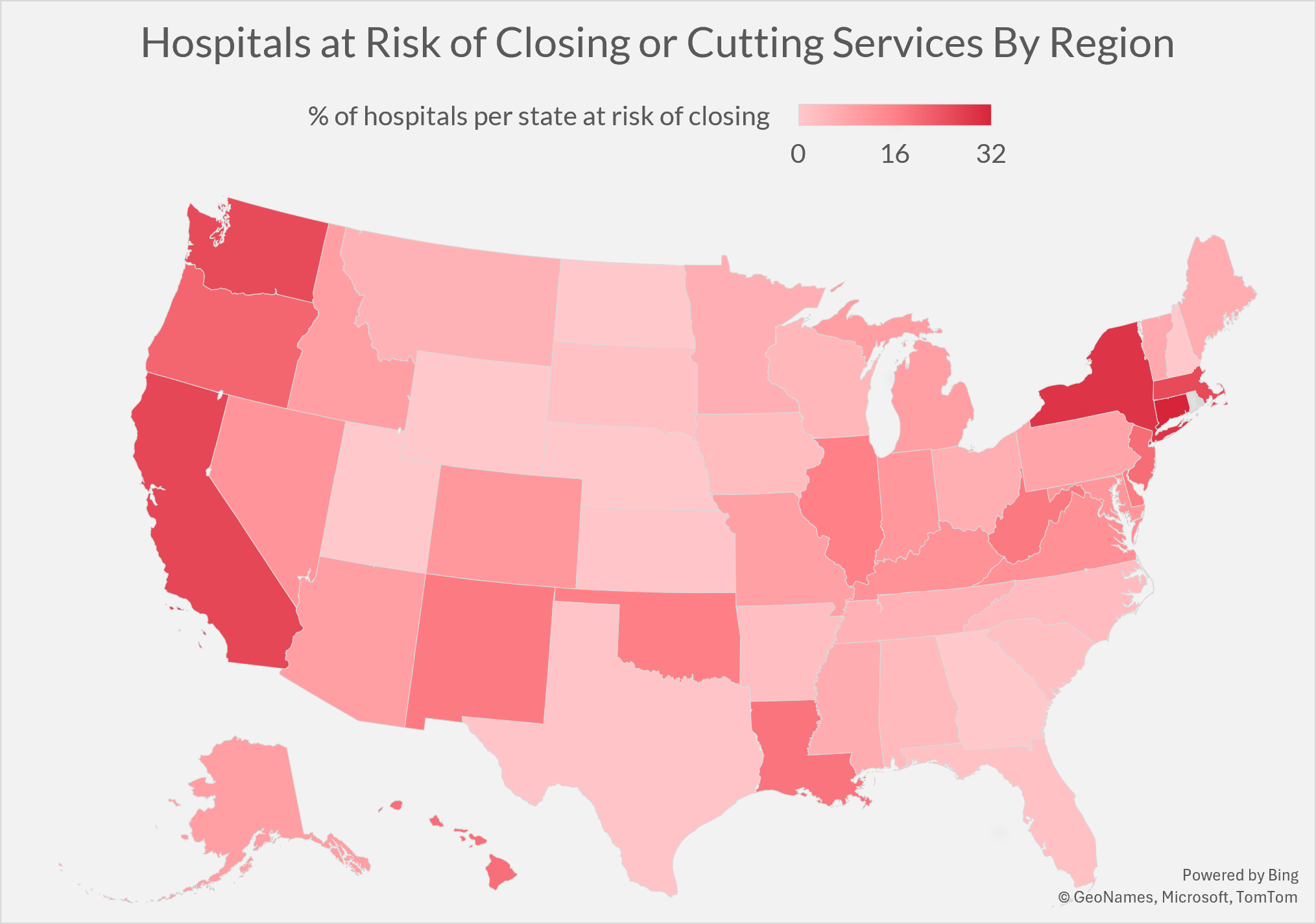
A map showing the percentage of hospitals in the US that are at risk of closing or cutting services. Source: Eileen O'Grady, PublicCitizen and National Academy for State Health Policy’s (NASHP) Hospital Cost Tool (HCT) Downloaded data for 2022-2024, dataset last updated on December 30, 2025. https://tool.nashp.org/
“[The Trump administration’s] cuts to Medicaid will hurt millions of low-income and disabled Americans, and will deepen financial strains that are already plaguing rural and safety-net hospitals,” said Eileen O’Grady, a researcher for Public Citizen and author of the report, in a press release.
Public Citizen identified 446 at-risk hospitals that are most likely to be affected by Medicaid cuts because they rely on federal Medicaid money and already had negative profit margins for 2022–2024. More than 1 in 4 of all hospitals in Connecticut, California, New York, Massachusetts, and Washington are at risk of closing, according to the report.
Compared to other hospitals, at-risk hospitals serve a larger share of Black and Hispanic people, as well as people living below the poverty line.
Most (60%) of the at-risk hospitals are in urban areas, while 39% are in rural areas. People in rural communities have higher rates of late-stage breast cancer diagnoses and face other unique health challenges. Eighty-four of the at-risk rural hospitals are the only hospitals within 35 miles of other facilities. Fewer hospitals, in either rural or urban areas, means less access to essential services like emergency care and cancer screenings.
Hospital systems in California, Georgia, Idaho, Indiana, and Virginia have all announced layoffs or reduced services due to Medicaid cuts. To avoid the closure of at-risk hospitals, the report urges Congress to restore Medicaid funding cuts and extend tax credits for coverage through the Affordable Care Act. Similar to Medicaid, hospitals are reimbursed by the government to provide services through the ACA. Without ACA tax credits, more people will be uninsured and hospitals and providers could lose $32 billion in revenue in 2026, according to a study by the Urban Institute.