Molecular Breast Imaging Spots Cancer in Dense Breasts That Mammograms May Miss

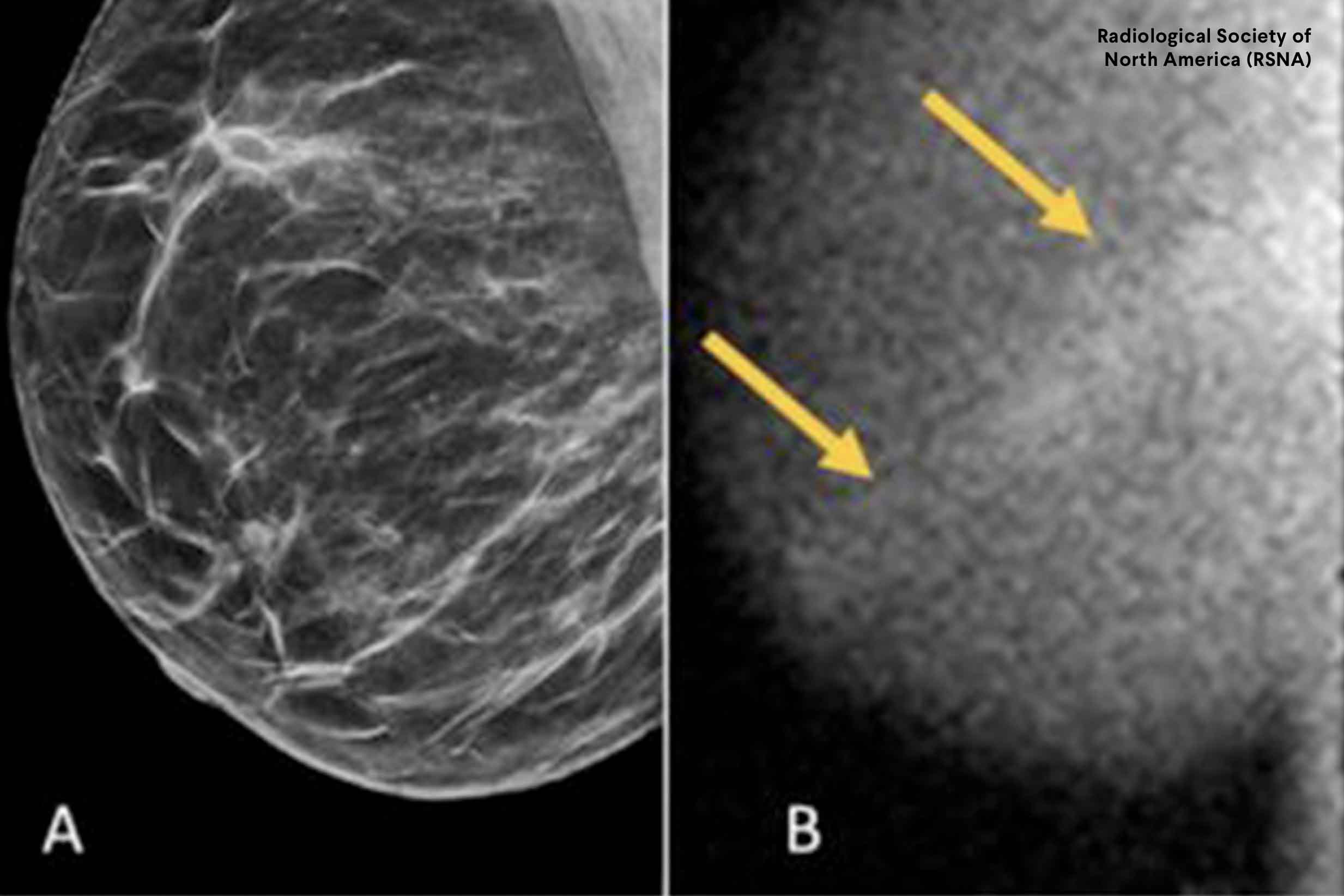
A combination of 3D mammograms and molecular breast imaging found twice as many cases of breast cancer in women with dense breasts as mammograms alone, according to new research from the Mayo Clinic.
Dense breasts are common: About half of women who get breast cancer screenings have them, according to the Centers for Disease Control and Prevention. Still, detecting breast cancer in dense breasts can be difficult using mammograms, since dense breast tissue and cancers both appear white on a mammogram and often bleed together. Although some organizations recommend supplemental screening for people with dense breasts, others do not, and it’s common for people to only receive mammogram screening.
“Breast cancers can hide from detection on a mammogram until they reach an advanced size,” said lead author Carrie Hruska, PhD, in a press release. Hruska is a professor of medical physics at Mayo Clinic. Hruska and her team wondered if an extra screening tool called molecular breast imaging could spot cancer that 3D mammograms miss. In molecular breast imaging, a small amount of a radioactive tracer is injected into a vein, and then the breasts are scanned to see if the tracer “lights up” any cancer.
Someone who’s having their routine annual screen every year should not be diagnosed with advanced breast cancer. That’s just unacceptable.
Nearly 3,000 women with dense breasts at Mayo sites across four states enrolled in a study to answer this question. The women, aged 40 to 75, had two annual screenings with MBI and 3D mammograms. If either screening came back positive, they received further testing to confirm the cancer.
Breast radiologists caught more cancer using the combined approach than either technique alone. MBI detected breast cancer in 29 women that was missed by 3D mammograms, and most of these cancers (70%) were invasive. “Someone who’s having their routine annual screen every year should not be diagnosed with advanced breast cancer,” said Hruska. “That’s just unacceptable. With a supplemental screening every few years, we hope to find cancers earlier and see the diagnosis of advanced cancer go way down.”
Hruska said molecular breast imaging is a safe and useful addition to breast cancer screenings for people with dense breasts. “I don’t want to discourage anyone from getting a mammogram, because they absolutely should,” Hruska said. “However, [3D mammography] doesn’t find all cancers, and women need to understand its limitations and consider how supplemental screening can fill the gap.”