Breast Cancer Research Highlights from ASCO 2026


The 2026 ASCO Annual Meeting is taking place May 29 to June 2 in Chicago and attracts thousands of people engaged in all aspects of cancer research, care, and advocacy. The American Society of Clinical Oncology (ASCO) is the world's leading professional organization for physicians and oncology professionals caring for people diagnosed with cancer. The organization aims to conquer cancer through research and education.
Breastcancer.org is reporting on the latest breast cancer news from the ASCO conference, as well as podcasting with advocates and experts.
Dr. Teplinsky breaks down this year's top breast cancer research
Tens of thousands of people follow Eleonora Teplinsky, MD, head of breast and gynecologic medical oncology at the Valley-Mount Sinai Comprehensive Cancer Center, on social media for her breast cancer research updates. She talked to The Breastcancer.org Podcast about the top breast cancer research at this year’s meeting and also weighed in on GLP-1 medicines and cancer.

Gedatolisib slows growth of some metastatic breast cancers
Gedatolisib, a new targeted therapy medicine, slows the growth of metastatic hormone receptor-positive, HER2-negative breast cancer with a PIK3CA mutation that grew during treatment with a CDK4/6 inhibitor and an aromatase inhibitor, according to the latest results from the VIKTORIA-1 study. When used in combination with Faslodex (chemical name: fulvestrant), with or without Ibrance (chemical name: palbociclib), gedatolisib doubled progression-free survival — how long a person lives without the cancer growing — compared to Faslodex and Piqray (chemical name: alpelisib). Progression-free survival was 5.6 months with Faslodex and Piqray and about 11 months with gedatolisib and Faslodex with or without Ibrance.
Earlier results from the VIKTORIA-1 study found that gedatolisib also improved progression-free survival in people with metastatic hormone receptor-positive, HER2-negative breast cancer without a PIK3CA mutation. The U.S. Food and Drug Administration is expected to approve gedatolisib in July 2026.
Can GLP-1 medicines stop cancer from becoming metastatic?
People with stage I, II, or III lung, breast, colorectal or liver cancer, taking a GLP-1 medicine may have a lower risk of the disease progressing to stage IV than those not on a GLP-1, according to results presented during a 2026 ASCO Annual Meeting media briefing.
“This is an association, not a cause,” said lead study author Mark David Orland, MD, of the Cleveland Clinic. “It doesn’t apply to all patients and all cancers. But the results are provocative and provide early evidence that future studies are worth pursuing.”
Some people with high-risk cancers may be able to skip chemotherapy
OPTIMA trial results suggest that people with early-stage hormone receptor-positive, HER2-negative breast cancer that seems to have a high risk of recurrence based on clinical features, such as many positive lymph nodes, may be able to safely skip chemotherapy if they have a low Prosigna genomic test risk of recurrence score.
Iain MacPherson, MD, PhD, professor of breast oncology, explained the study, the results, and why he thinks the findings will change practice on The Breastcancer.org Podcast.

Does Breast Cancer That Seems to Have High Recurrence Risk Always Need Chemo?
With guest Iain MacPherson, MD, PhD, FRCP
May 30, 2026Breast Cancer Treatment
Stereotactic radiation before surgery may lead to better outcomes for people with brain mets
In people with large brain metastases, stereotactic radiation before surgery to remove the metastases reduced local recurrence rates — the cancer coming back in the brain after surgery — and lengthened the time until the cancer grew compared to radiation after surgery.
The small, early NEO-TACTICS study included 55 people; about 22% of them had breast cancer brain metastases. After 12 months of follow-up, local recurrence rates were 16.4%, which are lower than the 20–30% reported in earlier studies. Since the NEO-TACTICS study was small and didn’t have a comparison group, the researchers said a larger, randomized trial is needed to confirm the findings.
Yoga reduces side effects in cancer survivors
Gentle Hatha yoga helped ease mood swings, anxiety, and fatigue in cancer survivors, all of which helped people sleep better, according to a study presented during a 2026 ASCO Annual Meeting media briefing. Among the 410 people in the Yoga for Cancer Survivors (YOCAS) study, 75% had been diagnosed with breast cancer.
“This … study shows that structured yoga may help relieve some of the most consistently reported and hard-to-treat issues in cancer survivorship, leading to decreased insomnia. It’s an important advance because it offers survivors … a non-pharmaceutical solution for reducing four different side effects at once,” said Fumiko Chino, MD, associate professor of breast radiation oncology at MD Anderson Cancer Center about the results.
Elinzanetant eases hot flashes no matter which hormonal therapy you’re taking
No matter which type of hormonal therapy women were taking for breast cancer, elinzanetant (brand name: Lynkuet) helped ease a number of symptoms, including hot flashes, sexual issues, and sleeping problems, according to the latest results from the OASIS-4 study. The benefits were seen whether women were on tamoxifen or an aromatase inhibitor, and did or didn’t have ovarian suppression.
People with breast cancer feel better after losing weight
Early results from the Breast Cancer Weight Loss (BWEL) study found that among people with early-stage breast cancer and obesity, a structured, phone-based weight loss program helped them feel better.
“These findings show not only that weight loss provides meaningful benefits for people who have both breast cancer and obesity, but also that this can be achieved in thousands of patients enrolled across many kinds of oncology practices,” said lead author Jennifer Ligibel, MD, during a media briefing. “We need to stop viewing lifestyle interventions as add-ons and integrate them into care.”
Ligibel, who is director of the Leonard P. Zakim Center for Integrative Therapies and Healthy Living at the Dana-Farber Cancer Institute, discussed the results onThe Breastcancer.org Podcast.

Losing Weight Boosts Quality of Life in Early-Stage Breast Cancer
With guest Jennifer Ligibel, MD
May 31, 2026Diet and Exercise
Mobile app improves quality of life for people receiving supportive care
People with advanced-stage cancer who were receiving supportive care for symptoms but not active cancer treatment had better quality of life and fewer unplanned hospital stays than people who didn’t use the SUPPORT+ app. The app sends a weekly reminder asking people to complete a short questionnaire about their physical and emotional symptoms, either themselves or through a caregiver. The app then offers advice on how to manage any mild or moderate symptoms, offering both medicinal and non-medicinal solutions.
“Keeping track of symptoms helps people get good care,” said Toby Christopher Campbell, MD, MS, chief of palliative care at the University of Wisconsin and an ASCO palliative care expert. “This is an important advance in supportive care.”
Giredestrant effective regardless of menopausal status
The latest results from the lidERA study show that taking giredestrant after surgery for early-stage hormone receptor-positive HER2-negative breast cancer lowers the risk of the cancer coming back (recurrence) better than tamoxifen or an aromatase inhibitor in both pre- and post-menopausal women. Giredestrant is a new oral selective estrogen receptor downregulator (SERD) that isn’t yet approved by the U.S. Food and Drug Administration.
The risk of developing metastatic disease was 42% lower in pre-menopausal women and 24% lower in post-menopausal women.
Lifestyle changes reduce the risk of HR-positive breast cancer coming back
Women with early-stage hormone receptor-positive breast cancer who ate a low glycemic index Mediterranean diet, added 30 minutes of brisk walking to their days, and took a vitamin D supplement had a 76% lower risk of cancer recurrence than women who didn’t make these lifestyle changes. The study results showed that the women also lost weight and had better blood sugar levels, suggesting better metabolic health. The researchers noted that these changes are safe, low-cost, and relatively easy to make.
Positive sentinel nodes? Skipping more surgery is safe, preserves arm function
Most people with early-stage breast cancer and positive sentinel lymph node biopsy results can skip invasive axillary lymph node surgery, as long as they receive appropriate treatment after surgery. This was the finding from the SENOMAC trial.
After one or two positive sentinel lymph nodes were found, half the 2,540 people in the study had axillary node surgery and half didn’t. Five-year survival rates were 94% for people who didn’t have axillary surgery and 93% for those who did. People who didn’t have axillary surgery also had much better arm function.
After surgery, nearly all the people in the study had lymph node radiation, 90% received hormonal therapy, and more than 60% received chemotherapy.
“Omission of complete axillary lymph node dissection should be the standard of care for [people with] breast cancer that has spread to one to two sentinel lymph nodes,” said lead study author Jana de Boniface, MD, PhD, of the Karolinska Institutet, during a media briefing.
Research posters look at reducing cancer and recurrence risk
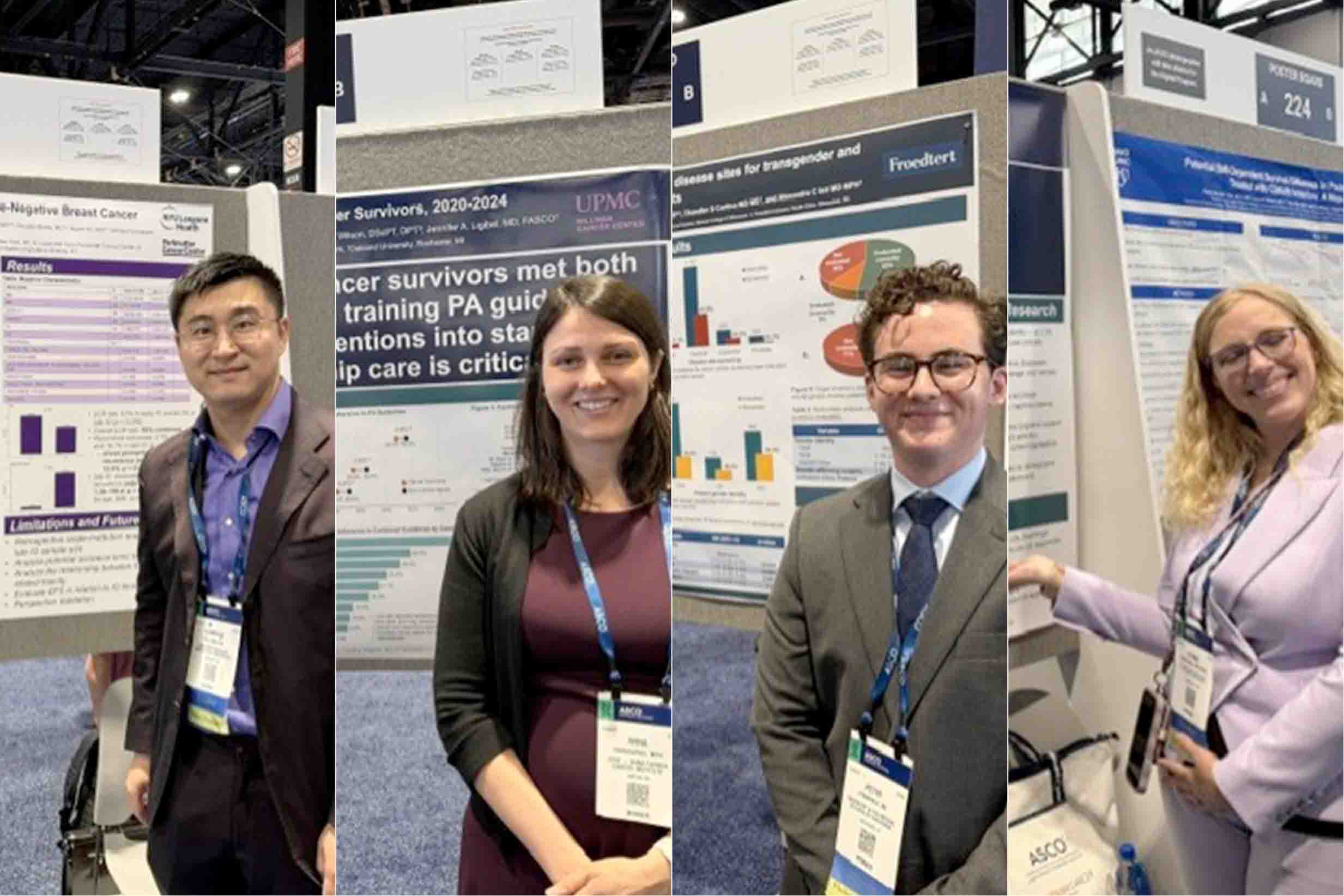
A poster session focusing on reducing risk featured several studies on breast cancer, including research on cancer screening in trans people, GLP-1 medicines and breast cancer in post-menopausal women, exercise in cancer survivors, and the timing of immunotherapy in people with early-stage triple-negative breast cancer. The scientists presenting the posters explained their work on The Breastcancer.org Podcast.
For women with family history, breast cancer risk calculators fall short
A review found that although some commonly used breast cancer risk calculators perform reasonably well, none were highly accurate at identifying which women would later develop breast cancer. Four risk models have been studied often enough to allow for detailed analyses: Gail, Tyrer-Cuzick, BOADICEA, and BRCAPRO.
The review found that the BOADICEA model was the most balanced when estimating future risk in women with a family history of breast cancer. The Gail and BOADICEA models offered risk estimates that were generally close to the number of breast cancers that actually occurred. The Tyrer-Cuzick model tended to overestimate risk and BRCAPRO tended to underestimate risk.
Keytruda before surgery shows benefits for early-stage TNBC
Final results from the KEYNOTE-522 study confirm that adding the immunotherapy medicine Keytruda (chemical name: pembrolizumab) to chemotherapy before surgery for early-stage triple-negative breast cancer with a high risk of recurrence helps people live longer without the cancer coming back as well as live longer overall compared to chemotherapy alone. After about seven years, more than 85% of the people who received Keytruda before surgery were alive, compared to 77% of people who received only chemotherapy.
Megan-Claire Chase, known online as Warrior Megsie, is part of this year's ASCO Voices, a program focused on personal narratives about oncology. Her talk was on how her perspective on clinical trials changed after she was diagnosed with stage IIA invasive lobular breast cancer. She talked to The Breastcancer.org Podcast about her evolving relationship with the health system, representation in clinical trials, and why she became an advocate.

Why My Perspective on Clinical Trials Changed
With guest Megan-Claire Chase
May 29, 2026Personal Stories
Antidepressant may ease fatigue in women with breast cancer
Bupropion, a medicine used to treat depression and help people stop smoking, seems to moderately reduce fatigue in women diagnosed with breast cancer. Of the 428 people in the study, 81% were women, 86% were white, and 73% had breast cancer; so the researchers cautioned that the results couldn’t be applied to all people with cancer. They also emphasized that bupropion (which is sold as the brand name Welbutrin, among others) can cause seizures, so doctors need to screen people for seizure risk factors, including brain tumors, eating disorders, and central nervous system tumors.
How one expert’s breast cancer diagnosis informs her global health research
Felicia Marie Knaul is a global health policy expert who got a breast cancer diagnosis while living in Mexico. Today her research is influenced by her diagnosis and treatment. On The Breastcancer.org Podcast she explains why she thinks controlling cancer can be a stepping stone to creating more effective and equitable health systems around the world.

Creating More Equitable Health Systems
With guest Felicia Marie Knaul, PhD
May 30, 2026Healthcare Disparities
This content is made possible by Lilly.