ESMO 2026 Breast Cancer Research We’re Watching

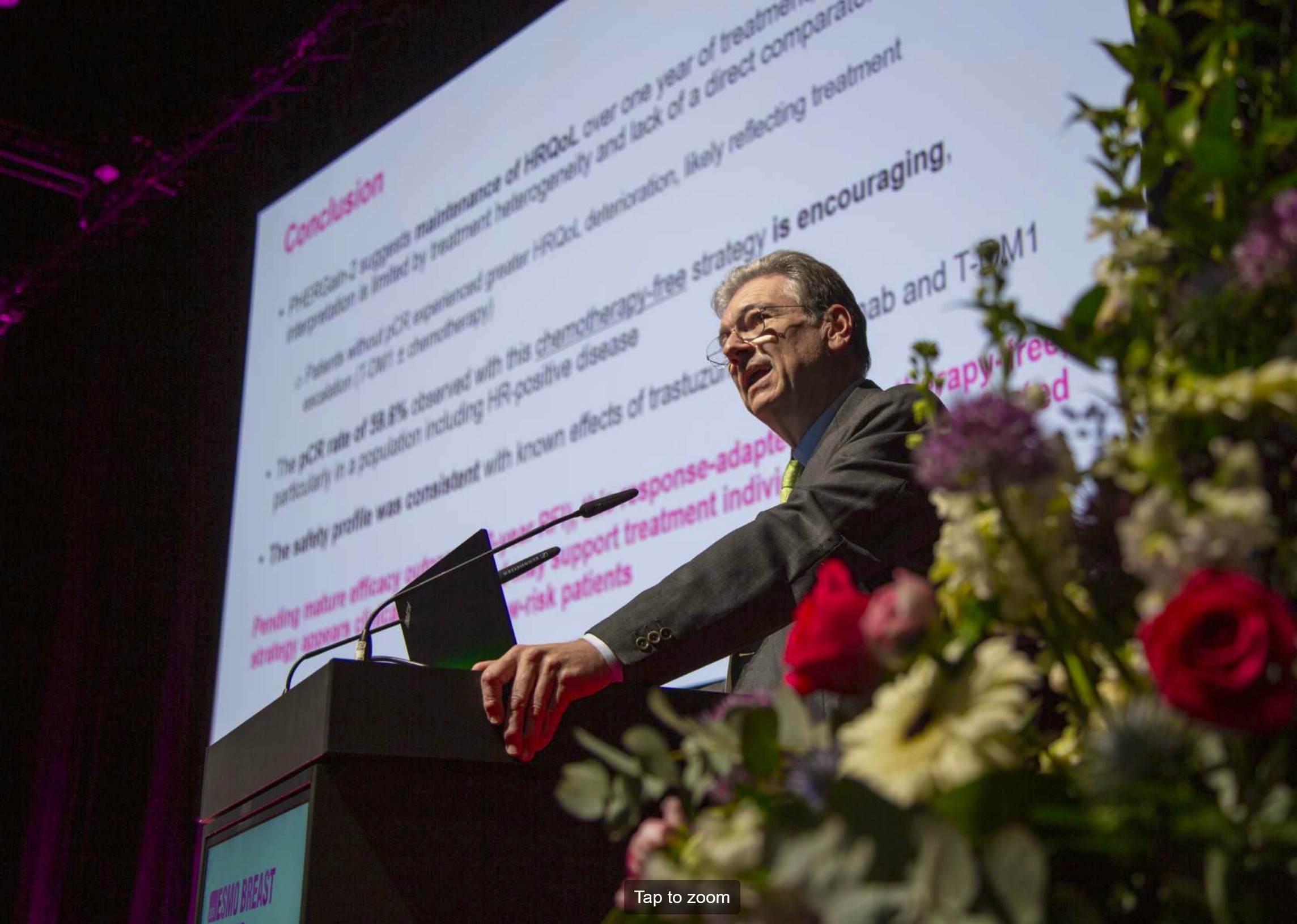
The European Society for Clinical Oncology (ESMO) Congress 2026 will take place Oct. 23–27 in Madrid. Thousands of international experts, researchers, and advocates will come together to discuss the latest breakthroughs in cancer from screening to diagnosis and treatment to survivorship. Breast cancer research we’re watching for includes updates on lobular breast cancer diagnosis and treatments, reports on experimental immunotherapy medicines, and next-generation treatments for metastatic breast cancer.
The ESMO Breast Cancer Annual Congress 2026, a companion conference focused on breast cancer, took place May 6–8 in Berlin.
We’re bringing you the top breast cancer research highlights from both meetings.
Top takeaways from ESMO Breast 2026
Can pCR show who can safely skip chemo?
Currently, many studies are looking at what doctors call de-escalating treatment. This means giving people fewer treatments or treatments that cause fewer and less severe side effects. To do this, researchers have been looking for new ways to predict who can safely skip certain treatments.
The researchers behind the PHERGain-2 trial wanted to know if people diagnosed with very treatable types of early-stage, HER2-positive breast cancer who have a pathological complete response (pCR) to treatments given before surgery can skip chemotherapy after surgery. A pCR means that no active cancer cells are present in tissue removed during surgery. It shows doctors that pre-surgery treatments were effective.
All the cancers in the study were very small, node-negative, and strongly HER2-positive, which means they would likely respond well to anti-HER2 medicines given before surgery. So these types of cancers would be more likely to have a pCR and less likely to need chemotherapy after surgery.
Early results from the study show that people with pCR who skipped chemo after surgery had better quality of life than people who received chemotherapy. But because these are early results, we don’t yet know if the rates of the cancer coming back (recurrence) are different between the treatment groups.
Using one ADC after another offers disappointing results
Results from the SATEEN trial showed that the combination of Trodelvy (chemical name: sacituzumab govitecan-hziy) and Herceptin (chemical name: trastuzumab) to treat metastatic HER2-positive breast cancer that grew during Enhertu (chemical name: fam-trastuzumab-deruxtecan-nxki) treatment wasn’t effective. Only one of the 27 cancers in the study responded to the combo treatment. Researchers had hoped the combination could be another option for people if Enhertu stops working.
It was one of the first prospective studies looking at using antibody-drug conjugates (ADCs) — Trodelvy and Enhertu — one after the other. The two drugs target different proteins, but they both use the same type of chemotherapy, a topoisomerase 1 inhibitor. Experts think resistance to the chemotherapy part of the ADC may explain the SATEEN findings. The results also echo real-world studies that have shown limited benefits for people receiving one topoisomerase 1 inhibitor ADC after another.

This content is made possible by Lilly.