Tissue Expanders and Breast Reconstruction
If you’ve decided you want breast reconstruction but either can’t — or don’t want to — have it right away, a tissue expander may be your best option. A tissue expander is a temporary breast implant with a small valve that can be filled over time with liquid or air. It’s placed under the chest skin or muscle after a mastectomy.
Why are breast tissue expanders used?
After a breast is removed during a mastectomy, breast tissue expanders are used to gradually stretch the skin and soft tissue for people who choose to have breast reconstruction. Tissue expanders create a pocket-like space that will eventually hold a breast implant. They also can be used to hold the space for breast reconstruction with a tissue flap taken from another part of the body, often the lower abdomen (belly).
Your treatment team may recommend getting tissue expanders so that you can finish certain cancer therapies, such as radiation or chemotherapy, before you have breast reconstruction surgery. You might also prefer to have more time to decide about the type of reconstruction you want (implant versus tissue flap). You can think of a tissue expander as a “placeholder” for the reconstructed breast until you’re ready to move ahead.
Some people who are getting breast reconstruction can skip the tissue expansion process and have the full reconstruction surgery at the same time as the mastectomy. You can ask your treatment team if that’s a good option for you.
What do breast tissue expanders look like?
A breast tissue expander is a balloon-like sac made of silicone. The key difference between an expander and a standard breast implant is that an expander starts out empty and is gradually inflated. Tissue expanders are also firmer than permanent implants.
Expanders have a valve or port so that they can be filled over time with either air or a sterile saltwater solution, also called saline solution. The plastic surgeon or nurse injects the saline or air through the skin (and into the port or valve) using a needle and syringe.
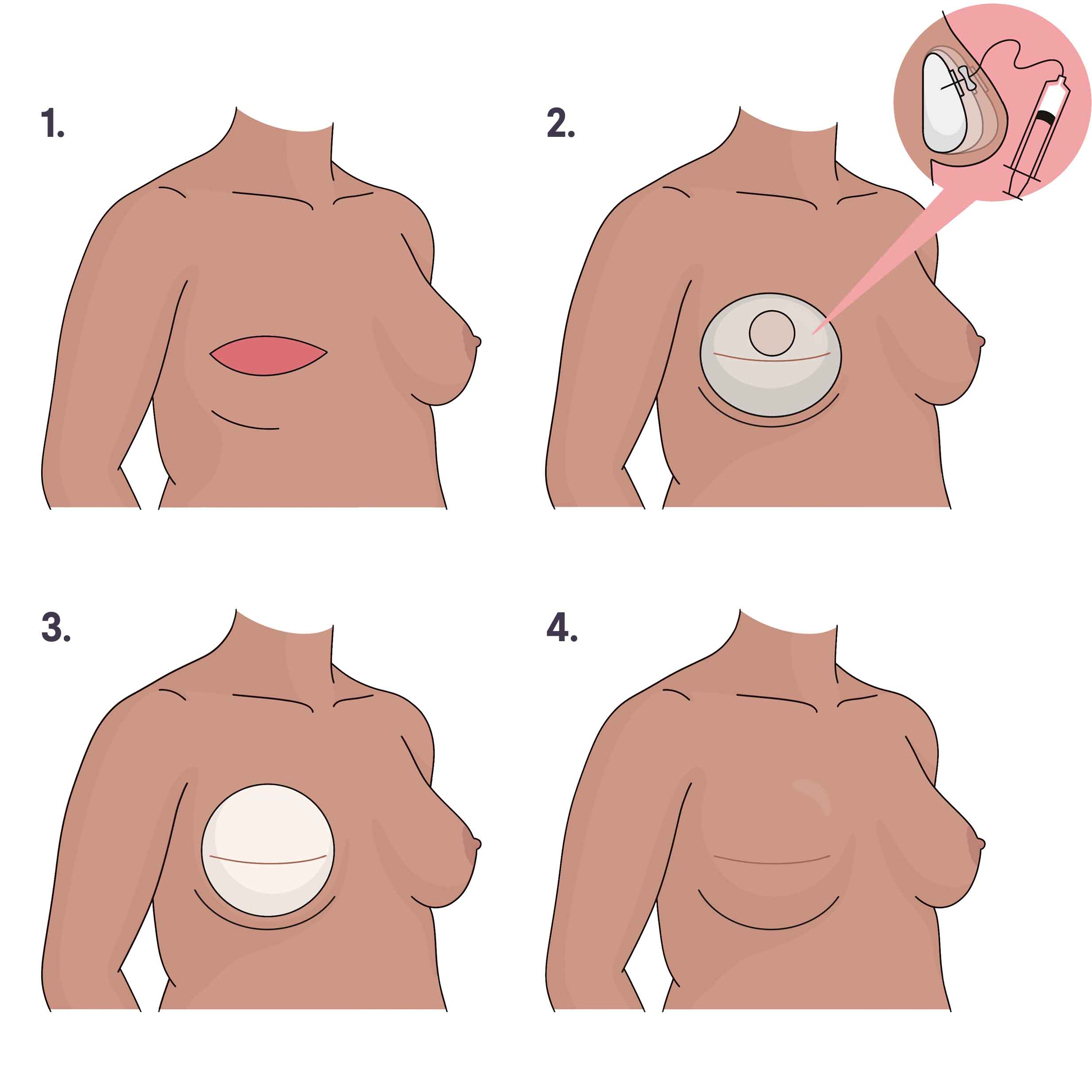
1. Breast tissue and nipple are removed. 2. A tissue expander is placed and gradually filled with sterile water over several weeks until it’s the preferred size. 3. The expander is exchanged for a permanent breast implant in a second surgery. 4. The breast, with implant, heals with a scar. Illustration by You Jeong (Julie) Park, MD.
What to expect with breast tissue expanders
In most cases, a tissue expander — or expanders, if you’ve had a double mastectomy — is placed by a plastic surgeon during the mastectomy surgery immediately after the breast tissue is removed. However, it also can be placed at a later date. Your treatment team can help you decide the best timing for your specific situation.
Once the tissue expander is in place, you can expect to see your plastic surgeon or nurse every week or so. They will fill the expander with saline solution or air through the port or valve. This continues until you and your surgeon are satisfied with the size and shape of the breast pocket. The process of filling the expander typically takes about six to eight weeks.
Tissue expanders can cause pain and discomfort, which might be worse when you first get them and after each time they’re filled. Some people find the pain harder to manage than others, and it’s worth talking with your treatment team ahead of time about different ways to ease it.
Before the procedure
Whether you’re having a tissue expander(s) placed at the time of a mastectomy or later on, after other cancer treatments are finished, talk to your plastic surgery team about all your reconstruction options. Your surgeon can help you weigh the pros and cons of each procedure. You also should discuss:
what size and shape you want your reconstructed breasts to be, if you’re having a double mastectomy
how the size and shape of the reconstructed breast can be matched to your other breast, if you’re having single mastectomy
These decisions will help your surgeon choose the right size tissue expander for you.
Tissue expanders can be smooth or textured. Textured tissue expanders may carry a very small risk of a rare cancer called BIA-ALCL. If you're concerned about that risk, you can ask your plastic surgeons to use smooth ones. Many plastic surgeons now only offer smooth expanders.
Tissue expander placement
Your surgeon can place the tissue expander(s) either underneath (subpectoral) or on top of (prepectoral) the large muscles in your chest, called the pectoralis muscles. They can tell you which placement makes the most sense for your situation.
For subpectoral placement, your surgeon will make a pocket under the chest muscle and place the expander there.
For prepectoral placement, your surgeon will place the tissue expander on top of the muscle, underneath the skin. They may use a small mesh sling or hammock to hold the expander in place. Many surgeons use a material known as acellular dermal matrix (ADM). This is a soft tissue substitute made from human or animal skin. The body absorbs this tissue as it heals.
Tissue expander follow-up appointments
Once your tissue expander(s) are in place, your surgeon will let you know when the filling process can begin. If you had your expanders placed during a mastectomy, you’ll need to wait a few weeks until those incisions have healed. Your surgeon also may want you to wait until additional treatments, such as radiation or chemotherapy, are completed.
If you had tissue expanders placed later on, as a separate procedure after a mastectomy and other treatments were done, the expansion process may start sooner.
Although schedules can vary, you can expect to see your surgeon every one or two weeks to have your expander(s) filled. Your surgeon or nurse will use the port to inject small amounts of saline solution through a tiny needle. The skin and the pocket underneath the skin or the chest muscle will expand gradually. The expansion process usually takes about six to eight weeks.
Generally, the expansion process stops when your breast reaches the size that you and your surgeon have agreed upon. If your surgeon is trying to match the expander side to your other breast before placing an implant, they will most likely add extra volume to the expander. That means that one side may look much bigger than the other, but it leads to a better cosmetic result once the permanent implant is placed. (If this lack of symmetry bothers you, you can use soft breast forms for a more balanced look.)
Managing pain and discomfort
Many people report that tissue expanders can cause pain, discomfort, and a feeling of tightness (you may also have a feeling of fullness in the first day or two after an expansion). The filling procedure itself isn’t usually painful, though. If you’re having pain after an expansion appointment, you can ask your surgeon about lowering the amount of liquid for your next filling.
The following strategies can also help with pain:
taking warm showers (starting 48 hours after the surgery). It’s best to aim the spray toward your back and let the water run over your chest. Bathing is not recommended until your incisions have healed and your treatment team gives you the OK.
applying a cold pack to the area (but not directly on the skin)
doing gentle arm and shoulder exercises that can help relieve tightness (you can ask your treatment team to show you how to do these)
seeing a physical therapist who specializes in breast cancer rehabilitation
using over-the-counter pain medications such as acetaminophen (Tylenol®) or ibuprofen (Advil®)
taking prescription pain medications, muscle relaxants, numbing creams rubbed on the skin, or local injections of anesthetics or nerve blocks. Ask your doctor if any of these make sense for you.
wearing a soft, supportive bra that doesn’t have an underwire
practicing mindfulness or other meditation techniques
Precautions during the expansion process
For the first couple of weeks after the expander(s) are placed, you’ll need to sleep on your back. You can use pillows to prop up your head and knees to keep you in that position. Some women prefer to sleep in a recliner if they own one or can borrow one for a few weeks.
After that, you can start sleeping on your side. You may find it helpful to use a full-length body pillow or smaller pillows to support your body. You should avoid sleeping on your stomach for at least the first month. Over time, you can start doing what’s most comfortable for you.
You should be able to return to your normal activities such as office work and light housework fairly quickly after each expansion. If you have a job that requires heavy lifting or lots of upper body movement, ask your treatment team when it is safe for you to return to work. Generally, lifting anything over five pounds (such as groceries, children, or pets) on the affected side of your body isn’t recommended for several weeks after a mastectomy with expander placement. Ask your treatment team what makes the most sense for your individual situation and lifestyle.
While gentle exercises and stretching are OK, you’ll want to avoid high-impact exercises that could jostle your chest, such as running, jogging, and jumping. Also avoid exercises that involve your chest muscles or put a lot of stress on your upper body.
You’ll also have some limitations on other activities, including:
Driving: It’s usually okay to start driving once you have full range of motion in your shoulder and are no longer taking any prescription pain medications. If the seatbelt is resting against your tissue expander (whether you’re the driver or a passenger), place some soft padding in between your chest and the belt.
Air travel: The ports in tissue expanders are made of metal and they can set off airport security devices. Ask your treatment team for a letter that explains that you are wearing a medical device, and be sure to bring it with you when you travel.
MRI scans: You will not be able to have MRI (magnetic resonance imaging) tests while your expander is in place. Again, this is because of the metal port. Other imaging tests are safe.
Tissue expander removal and replacement (exchange surgery)
About two months after expansion is complete, your surgeon will remove the expander and exchange it for a permanent breast implant. This can usually be done as an outpatient procedure, meaning you can go home the same day. Your surgeon will perform the procedure using the same incisions that were used for your mastectomy. The surgery takes one to two hours. If you’re having adjustments to your other breast to bring the two sides into balance, it will take longer.
If you’re having tissue flap reconstruction, you should expect a longer surgery. Your plastic surgeon will need to remove the flap from another area of the body, such as the lower abdomen, and move it into the space where the expander was. In this case, you may have to stay in the hospital for a few nights.
If you’re having radiation therapy, chemotherapy, or both after a mastectomy, you’ll need to finish those treatments before the exchange surgery. Depending on what treatments you’re having, you may need to wait anywhere from two to six months after finishing them to have your exchange surgery. You and your treatment team can determine the schedule that is right for you.
Risks of tissue expanders
As with any surgery, tissue expander placement comes with some risks. There is a risk of infection due to the expander itself, which the body views as foreign material. Radiation therapy can increase that risk.
There is also a risk that the expander could tear or leak. If you notice that your expanded chest area is suddenly getting smaller in between fills, call your doctor’s office. You may need another procedure to fix or replace the expander.
Another risk is called capsular contracture. This happens when scar tissue forms around expanders or implants. If you have intense pain or hardening in the area, call your doctor’s office.
Questions to ask your surgeon
Here are some questions you may want to ask your surgeon about tissue expanders and how they fit in to your reconstruction process:
Am I a good candidate for tissue expander(s)? Why or why not?
How long will I have the expanders in, based on my treatment plan?
Which types of breast reconstruction would you recommend for me?
Are you experienced with tissue flap reconstruction? If not, can you refer me to someone who is?
When do I need to decide about having an implant versus a tissue flap? Can this decision wait until expansion ends, or do I have to decide now?
Do you have any patients who have been through this process who would be willing to speak with me?

This information made possible in part through the generous support of www.BreastCenter.com.