Goldilocks Mastectomy: Is It Right for You?
The Goldilocks mastectomy is, for some, a "just right" middle option between a full breast reconstruction and going flat.
It's a newer procedure that combines a mastectomy and breast reconstruction in one surgery. After the surgeon removes the breast tissue, they use the remaining fatty tissue and skin to form new, smaller breasts.
The Goldilocks mastectomy can allow you to avoid some of the potential downsides and the more involved surgery (or series of surgeries) associated with implant or flap reconstruction.
The procedure has gotten more popular in the last 10 years. But not all surgeons have experience with it. If you’re interested in having a Goldilocks mastectomy, look for a plastic surgeon who performs it regularly and can work with your breast surgeon. In some parts of the country, that may be harder to find.
It’s also important to know who is a candidate for the Goldilocks procedure and how the final results compare to other forms of reconstruction.
Pros and cons of Goldilocks mastectomy
Some people like that Goldilocks mastectomy allows you to use your own tissue for reconstruction (without the risks of flap surgery), but the procedure does have some limitations.
Pros:
shorter and less invasive procedure compared with some other types of reconstruction
quicker recovery
less risk of certain complications
no implants or tissues from other parts of the body need to be used
some people like that the results can be similar to a breast lift or reduction surgery
Cons:
the reconstructed breast size is limited by the amount of tissue available; fewer options for size and shape of reconstructed breast
results aren’t as predictable
the reconstructed breast can flatten over time
there’s a significant risk of developing fat necrosis
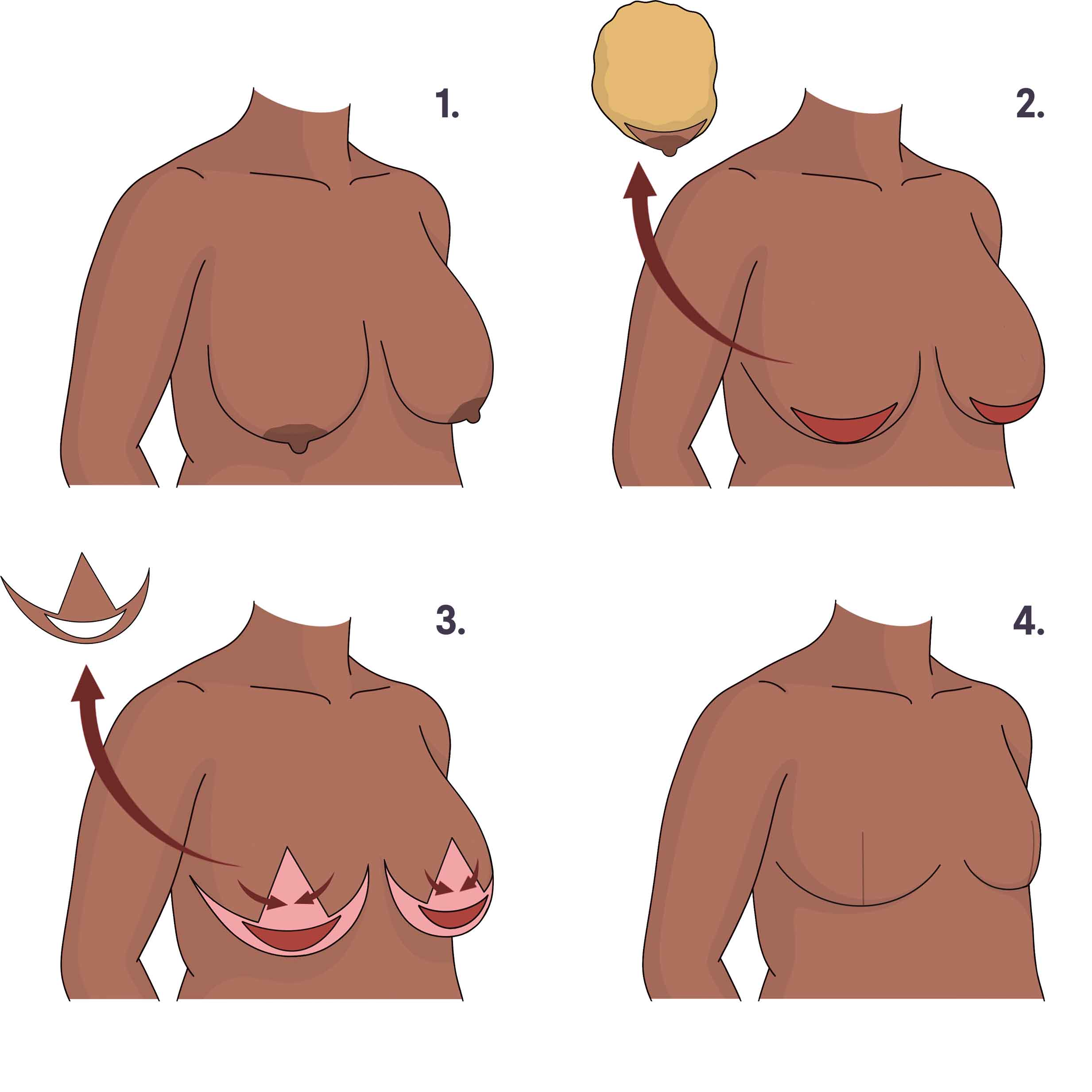
1. Breasts before surgery. 2. Breast tissue and nipples are removed. 3. An outer layer of skin is removed from the remaining breast skin. 4. Remaining skin and fat is rearranged to create small breast mounds, and incisions are closed. Illustration by You Jeong (Julie) Park, MD.
Who can have a Goldilocks mastectomy?
A Goldilocks mastectomy can be done on one or both breasts for breast cancer treatment or to lower breast cancer risk in those at high risk (a prophylactic mastectomy).
Experts say the procedure works best for people with larger breasts that have some droop (known as ptosis).
“It’s often someone who has a G, H, or I cup. And they need to be willing for the reconstructed breast to be a much smaller size,” says Brian Chang, MD, a board-certified plastic surgeon in private practice in the Washington, D.C. metro area who specializes in breast reconstruction.
People with smaller breasts usually aren’t candidates for a Goldilocks mastectomy because there isn’t enough extra skin for the surgeon to form breast mounds. Also, some people aren’t candidates because they have medical problems that affect healing, or they have scars in the breast area that could limit blood flow to the reconstructed breast.
How is Goldilocks mastectomy done?
A Goldilocks procedure is done at the same time as a mastectomy. First, the surgeon removes the breast tissue and any cancer. They then remove an outer layer of breast skin using an incision pattern that looks like an inverted “T,” known as Wise. Then they rearrange the remaining skin and fat to create small breasts.
A Goldilocks mastectomy may involve removing the nipples and areolas. Or, in people who are candidates, it can be done keeping the nipples and areolas intact (a nipple-sparing mastectomy), sometimes called a SWIM procedure.
A Goldilocks mastectomy takes about 1.5–2 hours if one breast is being rebuilt or 3 hours if both breasts are being rebuilt.
What results to expect with a Goldilocks mastectomy
After a Goldilocks mastectomy, the breasts are much smaller than they were before. The final result might be an A or B cup, or smaller. And your surgeon may not be able to tell you ahead of time what the results will be.
There’s a risk that the reconstructed breast will flatten and lose volume after the surgery. There’s also a higher risk of fat necrosis than with some other breast reconstruction surgeries. Fat necrosis happens when some of the fat in the reconstructed breast doesn’t receive enough blood flow and turns into hard lumps. And sometimes when patches of tissue don’t get enough blood supply, they turn black or blue and may need to be removed with surgery.
“I’ve found that when I do a Goldilocks mastectomy, the immediate result is nice but over time the volume flattens out and the skin can get bumpy. It doesn’t hold up long term as well as I had hoped,” says Nimmi Kapoor, MD, breast surgical oncologist and associate professor of surgery at the David Geffen School of Medicine at UCLA in Los Angeles, CA.
Still, Kapoor thinks the approach can make sense for some people.
“As long as you know what to expect and what some of the limitations are, and you can find a surgeon who has experience with it,” she says, “then it might be right for you.”
For some, the tradeoffs may be worth it. A Goldilocks mastectomy uses your own tissue rather than implants and tissue flaps from other parts of the body, and it has shorter surgery and recovery times than other types of reconstruction.
Using a Goldilocks approach to go flat
Sometimes a Goldilocks mastectomy refers to an approach to going flat (aesthetic flat closure).
This is when a surgeon uses a Wise pattern incision for the aesthetic flat closure, which can be done in women of all breast sizes.
“I’ve found that this can be a good way to do an aesthetic flat closure, especially in people with small breasts — A-cup or small B-cup — that are undergoing a nipple-sparing mastectomy,” notes Kapoor.
Optional add-on procedures
For some people, a Goldilocks procedure is the first step in the reconstruction process. They may choose to add more volume to the reconstructed breasts by getting additional procedures, such as:
adding tissue flaps: a flap (often a LICAP flap from the side of the chest) is added either during the Goldilocks mastectomy or as a separate surgery
fat grafting: fat from another part of the body is removed using liposuction and injected into the breast area
adding breast implants
Also, if your nipples were removed as part of a Goldilocks mastectomy, you may have the option of getting nipple reconstruction and/or nipple tattoos.
Like other types of mastectomy and breast reconstruction, Goldilocks mastectomy and follow-up procedures are usually covered by most insurance plans.
This information made possible in part through the generous support of www.BreastCenter.com.