ASCO 2026 Poster Session Research
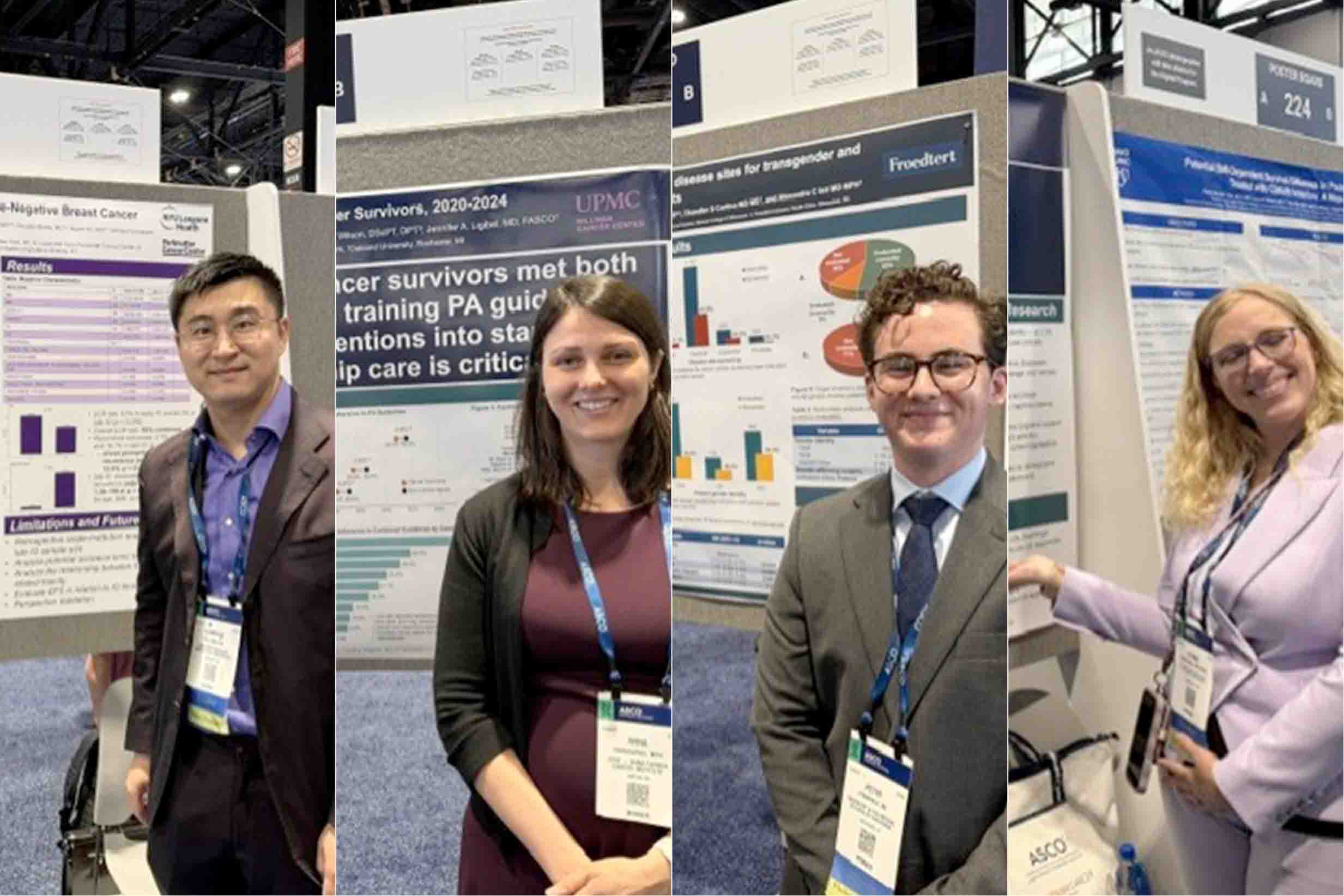
At the 2026 American Society of Clinical Oncology Annual Meeting poster session, we asked four scientists to discuss their research.
Listen to the episode to hear:
- Sponsor Message
Peter Stanfield, of the University of Wisconsin, explains his research on cancer screening rates in transgender and gender-diverse people.
- Sponsor Message
Nico Gotera, of the University of Texas Health Science Center, explains research on GLP-1 medicines and rates of breast cancer in postmenopausal women.
- Sponsor Message
Anna Tanasijevic, of the Dana-Farber Cancer Institute, explains research on how much cancer survivors exercise.
- Sponsor Message
Xianghui Zou, of NYU Langone Health, explains research on the timing of immunotherapy infusions for people with early-stage triple-negative breast cancer.
Welcome to The Breastcancer.org Podcast, the podcast that brings you the latest information on breast cancer research, treatments, side effects, and survivorship issues through expert interviews, as well as personal stories from people affected by breast cancer. Here's your host, Breastcancer.org Senior Editor, Jamie DePolo.
Jamie DePolo: At the 2026 American Society of Clinical Oncology Annual Meeting, I visited one of the poster sessions and asked four scientists to explain their research.
Peter Stanfield: My name is Peter Stanfield. I’m a second-year medical student at the Medical College of Wisconsin, and I am here at the ASCO Annual Meeting to talk about cancer screening rights in our transgender and gender-diverse patients. So, we have a growing number of people in the United States that identify as transgender or gender-diverse, but we don’t have a lot of great data on their cancer screening rights. So, what my team and I set out to do was to define rates of cancer screening for four key disease sites and then to better describe the use of the organ inventory in our electronic medical record.
So, we conducted a study of students or patients who were seen at our institution. We had a cohort of about 2,400 patients, about a third of them were transgender men, a third of them were transgender women, and another third were gender-diverse or nonbinary. We found really poor rates of cancer screening in breast cancer, cervical cancer, colorectal cancer, and prostate cancer. When we compare this data to national data from the National Cancer Institute, we can see that there is a very stark difference in the way that transgender people are being screened for cancer.
Breast cancer, specifically, we found about 137 people needed to be screened for breast cancer, but only about half of them were. We don’t know exactly why that is yet, but it’s something that we really want to look into more in the future.
When we look at cervical cancer specifically, we can see a difference in the way that transgender men and our gender-diverse patients are being screened. Gender-diverse patients were more likely to be up to date on their cervical cancer screening. Again, we’re not too sure of why this is yet, but it’s something that we want to look into more in later studies.
And finally, we also found really poor rates of use of the organ inventory in our electronic medical record. The organ inventory is a tool that allows doctors or nurses to note what organs a patient has present at birth and what they might’ve had surgically constructed or removed. So, obviously this has a lot of use for our transgender patients, but it could also be useful for women undergoing risk-reducing mastectomies or other elective procedures. We found really poor rates of organ inventory use across the entire cohort of patients, but especially in our gender-diverse patients; only 27% of them had a completed and correct organ inventory.
Now with all of that doom and gloom, we have one bright spot that we want to share. Patients who were seen at our LGBTQ+ health clinic that specializes in treating sexual and gender minorities, had greater odds of being up to date on cervical cancer screening, as well as having a complete and correct organ inventory. So, that really gives us some hope that gender-conscious and gender-informed care can be really useful in reducing the differences that we see in cancer screening for our trans and gender-diverse patients.
Jamie DePolo: Let me ask you one question. For the organ inventory, that is something, I’m assuming, that a person’s physician would fill out. That’s not on the person, is that correct?
Peter Stanfield: I believe in some places that can be self-reported data. It might be something that is available on an intake form, kind of the way that one might report whether or not they’ve had high blood pressure or diabetes in the past. Similar questions can be asked that, you know, kind of makes that conversation around cancer screening easier, especially if you’re somebody who has had gender-affirming care or gender-affirming surgeries, that might impact.
Jamie DePolo: I just thought of that because you said people that went to the LGBTQ+ clinic were more likely to have that filled out. And it just seems a physician in that clinic more sensitive to the needs of those patients would be more likely to fill that out.
Peter Stanfield: Yeah, absolutely. I think the physicians and the other providers that work in the clinic are very aware of how good of a tool that is, and how wonderful of a resource that is, and so maybe that’s why they’re more likely to fill it out.
Jamie DePolo: Thank you so much
Peter Stanfield: Thank you.
Dr. Nico Gotera: Hi, my name is Dr. Nico Gotera and I’m from UT Health San Antonio. And today I’m going to be talking about our study on GLP-1s and breast cancer incidence. We know that obesity is on the rise and it increases a risk of post-menopausal breast cancer, but there are not that many studies on the impact of GLP-1s on the increase of breast cancer incidence. So, one of the things that we did is that we looked at multiple patients, over 150 million patients over the past 15 to 20 years, and those with a BMI greater than 30.
And what we saw is that patients, in average, over a median of 2,790 days, there was a modest reduction in breast cancer incidence of about almost 16%. The big takeaway point, though, is that essentially, we still need to do more studies of prospective data on whether or not GLP-1s will be beneficial in assisting with breast cancer incidence.
Jamie DePolo: And let me ask you, so this is a retrospective study, I’m assuming.
Dr. Nico Gotera: Yes.
Jamie DePolo: So, everybody who was taking a GLP-1 they were taking it for an indicated theme, so they were either overweight or obesity or they were diabetic. So, I guess, where I struggle with some of this research is can we apply it to people who are not diabetic and who do not have overweight or obesity?
Dr. Nico Gotera: So, it’s a great question and something definitely that needs to be explored, definitely hypothesis-generating for what we do for the next steps. But yes, approved indication right now is for diabetes and obesity, but possibly thought as ancillary to what we already have out there too.
Jamie DePolo: And one more question. Did you look at all of the different types of GLP-1 medicines, because there are so many now. And I realize, I can’t remember when you said your study ended, 2019, is that right?
Dr. Nico Gotera: Oh, I think up to, like, I pulled that from even now like 2026.
Jamie DePolo: Oh, okay. So, did you look at any differences between the types of GLP-1s?
Dr. Nico Gotera: So, we actually did a subgroup analysis and what we saw is semaglutide, tirzepatide, dulaglutide, they were all pretty consistently shown to decrease the risk of breast cancer incidence, and with different, like, subgroups of high-risk women with breast cancer.
Anna Tanasijevic: Hi, my name is Anna Tanasijevic, I am the associate director of research operations for the Zakim Center at Dana-Farber and Dr. Jennifer Ligibel’s Lab. I am presenting a poster today called Leisure-Time Physical Activity Among US Cancer Survivors and the primary author on this study is Dr. Roxy Wang. She is a post-doc in our lab and she’s unable to be here today, so I’m presenting on her behalf. This study looked at data from 2020 to 2024 from the National Health Interview Survey and our goal was to determine the patterns of aerobic and strength training exercise in cancer survivors.
And we looked at any US adults aged over 18 who had ever had a cancer diagnosis in this dataset, and we estimated the age-adjusted prevalence of meeting aerobic and strength training guidelines. What we found was that fewer than one in four cancer survivors met both the aerobic and strength training physical activity guidelines. We found that African-American patients, Hispanic patients, and older patients were less likely to be meeting these guidelines. We found that patients with gynecologic cancers and lung cancer were less likely to meet both guidelines, and patients with GI cancers were less likely to meet the strength training guidelines.
The future implications of this work are that we obviously need to continue increasing access to physical activity interventions and programs so that patients can increase their physical activity. Because we know that physical activity improves quality of life and treatment-related side effects, and hopefully has impacts on overall survival in these patients.
Jamie DePolo: Let me ask you one thing, and if you don’t know this, this is fine. How did the people with a history of breast cancer do in the study, per se?
Anna Tanasijevic: That’s a very good question. So, it looks like 18% of breast cancer patients reported an adherence to the combined guidelines, whereas the general population, so non-cancer adults, reported 22.2%. So, they were pretty close to what the general population or the non-cancer patients reported, yeah.
Jamie DePolo: So, not too bad, but still not, not way below half.
Anna Tanasijevic: Yes. Yeah, so not quite meeting the guidelines. And it’s tough, I think, you know, and I don’t know exactly at what point patients were in their survivorship journey. So that will probably be future analyses can look into that. And also, I’m not sure what types of treatment patients were on when they were in survivorship, so I don’t know that this dataset gave us that level of nuance, but we are hoping to do those analyses in the future.
Dr. Xianghui Zou: Hello, my name is Dr. Zou, I am from New York. I work in NYU Mineola Perlmutter Cancer Center. Our study studies how timing of the immunotherapy affects patient outcomes in triple-negative breast cancer, early-stage.
Last year at ASCO, there was a randomized phase III controlled trial in China that identified that patients who get immunotherapy later during the day had a worse outcome in metastatic lung cancer. So, nobody has looked at the outcome in triple-negative breast cancer in early-stage that’s why we started this retrospective study identifying whether timing of immunotherapy affects patient outcomes.
So, we have a database of 139 patients all throughout NYU Perlmutter Cancer Center at multiple campuses. We look at patients who got neoadjuvant KEYNOTE-522, which has pembrolizumab, in this regimen between July ‘21 and June 2025. We defined late timing as 12:22 and the timing is really specific because we lumped all patients timing and we picked a median time as the cutoff. And we define for patients who get all first three infusions after 12:22 as late. We obviously collected like, you know, baseline characteristics, but our outcome is we want to look at, does timing of immunotherapy affect pCR, pathologic complete response, and does timing of immunotherapy affect recurrence of disease, local recurrence, distant recurrence, or death?
What we found first is that for patients who received immunotherapy early, which is 108 patients, they are actually a little younger than patients who were receiving immunotherapy late, which is 31 patients. Now, you may be wondering why is there such a discrepancy between early versus late regarding the number, one is 108 and the other 31. And the reason behind that is that our cutoff for late is quite stringent. You have to be late three times in a row and after a certain time point, so because of that we only have 31 late patients. But we think that this really fits our mechanism that, you know, your immune system may be waking up in order for this to work down the line, so that’s why did like three times in a row.
But interestingly, what we found is that for patients who get immunotherapy earlier, they have a better pCR rate, pathologic complete response rate. It’s like about 60-something percent or 40-something percent. It is not significantly significant, but is clinically a big difference. But more importantly what we found is that for patients who get their immunotherapy late, they have a much higher recurrence rate, which is 16.1% compared to patients who got their immunotherapy early, which is only 3.7%. So, this tells us that the pCR rate is clinically significant, but what really carries forward is the recurrence risk, specifically the distant recurrence.
So, for our future directions we do want to look at why people come to immunotherapy late, we want to look at, are there any socioeconomic barriers regarding that? And then, you know, eventually it would be nice to look at event-free survival data, regarding how soon do people who get immunotherapy early versus late relapse? And it would be a, you know, the greatest method to do it prospectively, but obviously understand that, you know, there will be limitations regarding that.
We hope that this study can be operational changing, although I do realize the challenge behind it, but at least we propose something that is really beneficial with minimal harm.
Is it feasible that everyone gets immunotherapy early and the other chemo patients come later? There are chemo regimens that requires like a whole day infusion. For example, FOLFIRINOX is a regimen that has three chemo agents in it and requires scalp cooling, like lots of stuff pre and post.
Jamie DePolo: Right.
Dr. Xianghui Zou: So, it will be almost impossible for those patients to come later during the day because then they’re going to sleep, like, in the infusion center and that’s just not feasible.
Jamie DePolo: Right.
Dr. Xianghui Zou: But if you schedule your patients carefully, I think we can emphasize on shorter immunotherapy earlier in the morning, but I understand there are a lot of operational obstacles during this process and I don’t anticipate this to be effective like immediate.
Thank you for listening to The Breastcancer.org Podcast. Please subscribe on Apple Podcasts, Amazon Music, Spotify, or wherever you listen to podcasts. To share your thoughts about this or any episode, email us at podcast@breastcancer.org or leave feedback on the podcast episode landing page on our website. And remember, you can find out a lot more information about breast cancer at Breastcancer.org and you can connect with thousands of people affected by breast cancer by joining our online community.
Peter Stanfield is a second-year medical student who's passionate about cancer care, with a special interest in advancing equitable care for LGBTQ+ patients and eliminating healthcare disparities.
Nico Gotera, DO, MPH, is a clinical assistant professor at UT Health San Antonio.
Anna Tanasijevic, MPH, is the associate director of research operations for Dana-Farber's Zakim Center for Integrative Therapies and Healthy Living.
Xianghui Zou, MD, MPH, is a Hematology and Medical Oncology Fellow at the NYU Grossman Long Island School of Medicine.
Your donation goes directly to what you read, hear, and see on Breastcancer.org.