Cooling and Compression to Prevent Neuropathy
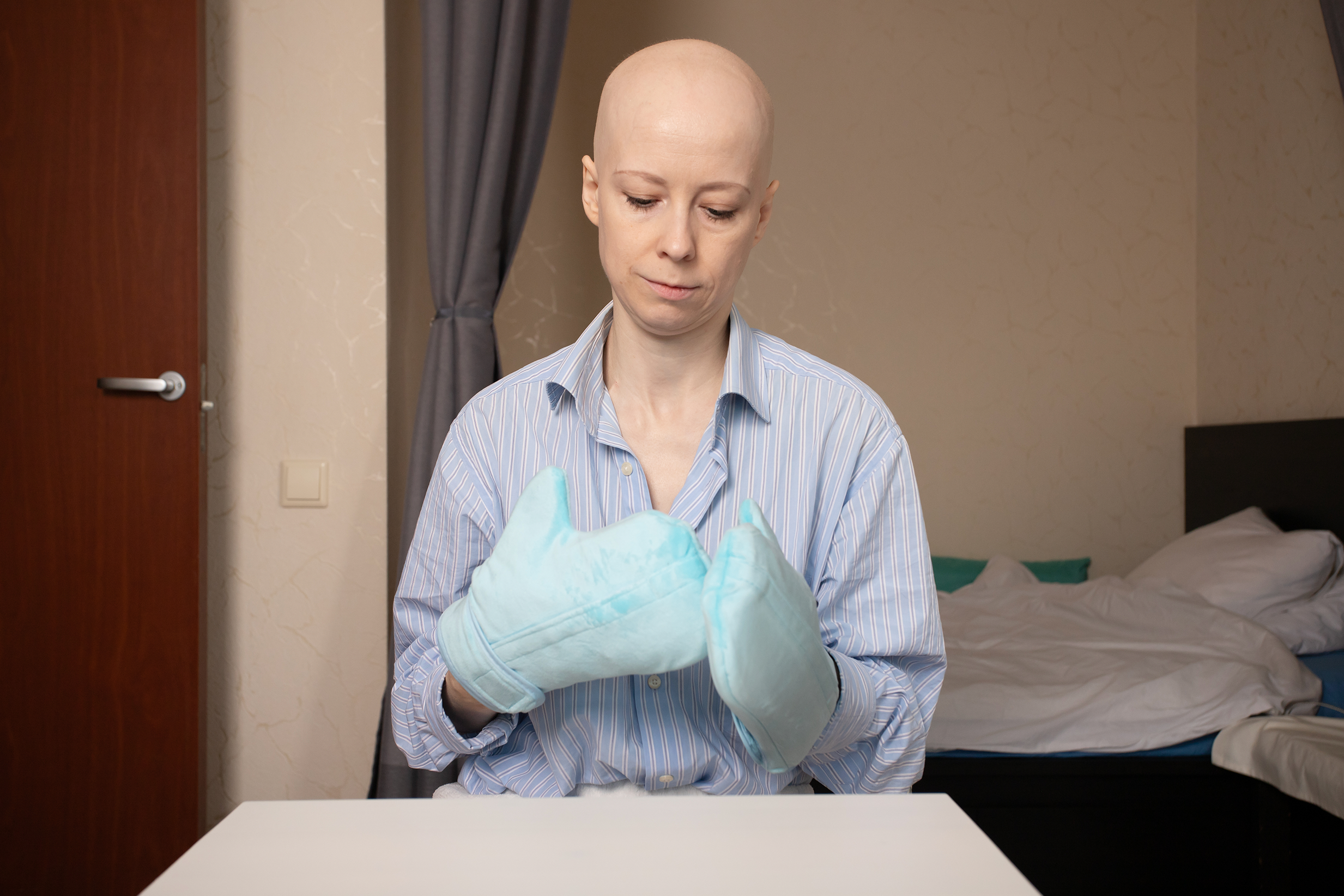
Peripheral neuropathy is damage to the nerves that run to your hands, feet, arms, and legs. Neuropathy can cause burning pain, numbness, tingling, or muscle weakness in the areas that are affected. Chemotherapy, especially medicines called taxanes – Taxol, Taxotere, and Abraxane – are common causes of neuropathy in people receiving breast cancer treatment. While there are treatments that may help ease the symptoms of neuropathy, there is nothing available that can repair the damaged nerves. So studies are looking at ways to prevent neuropathy in the first place.
Dr. Eleonora Teplinsky, head of breast and gynecological medical oncology at Valley-Mount Sinai Comprehensive Cancer Care in Paramus, New Jersey, is the principal investigator at her institution of the ICE COMPRESS study, which is looking at cooling mitts and socks and compression to prevent neuropathy during chemotherapy. The study is being done at more than 20 sites across the United States.
Listen to the episode to hear Dr. Teplinsky explain:
- Sponsor Message
risk factors for neuropathy
- Sponsor Message
the rationale for the ICE COMPRESS study
- Sponsor Message
her advice to people who want to try icing and compression on their own during chemotherapy
Welcome to The Breastcancer.org Podcast, the podcast that brings you the latest information on breast cancer research, treatments, side effects, and survivorship issues through expert interviews, as well as personal stories from people affected by breast cancer. Here's your host, Breastcancer.org Senior Editor, Jamie DePolo.
Jamie DePolo: Hello, thanks for listening. Peripheral neuropathy is damage to the nerves that run to your hands, feet, arms, and legs. Neuropathy can cause burning pain, numbness, tingling, or muscle weakness in the areas that are affected. Chemotherapy, especially medicines called taxanes, which are Taxol, Taxotere, and Abraxane, are common causes of neuropathy in people receiving breast cancer treatment. While there are treatments that may help ease the symptoms of neuropathy, there’s nothing available that can repair the damaged nerves. So, studies are looking at ways to prevent neuropathy in the first place.
I’m joined by Dr. Eleonora Teplinsky, head of Breast and Gynecological Medical Oncology at Valley-Mount Sinai Comprehensive Cancer Care in Paramus, New Jersey. She’s also very active on social media and hosts The Interlude Podcast about people affected by breast cancer. Dr. Teplinsky is the principal investigator at her institution of the ICE Compress study, which is looking at cooling and compression to prevent neuropathy during chemotherapy. The study is being done at more than 20 sites across the United States.
Dr. Teplinsky, welcome to the podcast. I'm very excited to talk to you about this topic.
Dr. Eleonora Teplinsky: Thanks for having me. This is such a great topic, and I find it really great that we're taking some time to discuss it.
Jamie DePolo: So, how common is peripheral neuropathy among people with breast cancer or specifically among people who get chemo for breast cancer?
Dr. Eleonora Teplinsky: It's really common. There are many different chemotherapy drugs that can cause neuropathy, as well as some of the targeted therapies that we're increasingly using more often. But in breast cancer particularly, we use a lot of taxane chemotherapy. So, that's either paclitaxel or docetaxel, and these drugs definitely can cause a significant risk of neuropathy. You know, and it varies by study, and it varies based on certain risk factors, but it's very common.
And patients often need to either dose reduce their chemotherapy, or sometimes they're not able to finish the planned course of chemotherapy because they do develop symptoms that can range, you know, anywhere from some mild numbness, to mild tingling, to acute pain, or to the point where it's impacting their balance and their walking and sensation. And so the manifestations are pretty broad, and it varies.
For many people, after finishing chemotherapy, the neuropathy does start to improve over the next few months. But in some patients, severe neuropathy can persist. And I think one of our challenges has really been that we don't always have a great sense of how much the neuropathy will improve and when.
So when someone develops neuropathy, we're not always able to say, well, in three months, it'll be this. You know, we don't always have that predictive, and that makes it really hard to think about, are we going to dose reduce the chemo? What are we going to do with the chemo? How do we counsel our patients? And so, this is why modalities being explored, like cryotherapy and compression therapy that we'll talk about, are so important, because these are really looking to see if we can reduce the incidence of neuropathy before it starts, rather than treating it when it develops.
Jamie DePolo: Is there any link between the severity of the neuropathy and the likelihood that it might get better? Or does that not matter?
Dr. Eleonora Teplinsky: Yes, we do know that when you stop the chemo, in general, it usually gets better. Sometimes patients do tell me that it does worsen before it improves. But yes, typically, if it's milder, we'll see, you know, more improvement, whereas if it's severe and they're not able to walk and it's affecting their balance and things like that, then it is less likely to, you know, completely reverse. But it's really individualized, and sometimes, we can't predict it, which I think is where the challenge really lies.
Jamie DePolo: Sure, and you mentioned some risk factors. Are there things that people could do, aside from what we're going to talk about, that's more, I guess, medical, for lack of a better term, to prevent neuropathy? Like, I believe I read, at one point, that somebody who has excess weight might be at a higher risk for neuropathy, or is that not true?
Dr. Eleonora Teplinsky: Yeah. I mean, there's a lot of studies that are looking at, can we prevent neuropathy? And there have been a lot of things that have been tested and really have not shown a benefit to prevent neuropathy.
There's a number of supplements people always ask about, and really, there's nothing there that we can definitively recommend as a preventive measure. There are some interventions that, you know, may be beneficial and have limited harm. So, things like exercise and acupuncture and acupressure and reflexology, you know, again, they may be helpful, but those really still fall under the treatment arm.
One of the things that we do recommend is checking a vitamin D level before someone starts a taxane chemotherapy. Now what's interesting about that, is that vitamin D has been shown to be a risk factor for neuropathy. So in studies that have said patients who had a low vitamin D or vitamin D deficiency did have a higher risk of neuropathy, what we don't know is, does repleting vitamin D — so does treating their vitamin D deficiency — actually then lead to improvement in neuropathy? I mean, there are a number of studies looking into that, so really testing that, but I think, given that we know low vitamin D is a risk factor, it seems easy to check and replete, and treating vitamin D deficiency will have other benefits, as well.
Jamie DePolo: Sure. So, let's talk about cooling compression. Where did that start, that somebody thought that, either both together or individually, that those could help prevent neuropathy? Do you know?
Dr. Eleonora Teplinsky: There were a number of studies, very small. We have these studies, you know, 40 patients, 80 patients, that started looking at either cooling, so with ice or wearing cooling gloves and booties, or compression. Some of the ways that they did compression was actually just wearing one-size-too-small surgical gloves on the hands, those kind of things. And started to show that, perhaps, there was improvement in cooling or compression, and one of the ways that they would do that is they would have, like, one hand that received cooling or compression and the other hand that didn't, and so, they were able to compare the two. But you know, all of these studies are fairly small. And they do have some signal that it may be beneficial, but there have been, also, some studies that said, well, maybe it's not as helpful as we think.
And the challenge with all of these studies is that they have all done cooling or compression in a different way. So it makes it really hard to standardize, because you don't know, well, what was the temperature of this, right? Putting your hands on ice is very different than using a cooling glove, like, a mitt that you freeze and you bring to the infusion center. We started at our institution years ago, we said, we really want to try this. You know, the data’s early, but it might help, and there's, for the most part, really no harm.
Again, there are some patients where we think people have, like, Raynaud’s and stuff that we wouldn't recommend doing this for. So we started doing it, and we started having everyone put their hands on ice. So first of all, that's really cold, and then the ice would melt, and our nurses were concerned, what if the water spills? It's a fall risk, right? What if one ice piece drops on the floor and then the patient trips and falls? So we really said we have to get away from this because this is a safety, you know, concern.
So then we went to the cooling gloves and booties — and you can get these on Amazon — and I always describe them to patients. They're kind of like oven mitts, but they come with these gel inserts that you freeze and you stick in the gloves and in the booties. Problem with that, again, is the patients have to bring them here in a cooler, and maybe it's a hot day outside and they have a long drive, and you know, maybe they've melted and warmed up. So again, you see there's a lot of variability in the temperature and in how it's being done. And so, there's really been a need to standardize this approach and to really test it in a large clinical trial.
So this is where the ICE COMPRESS trial comes in. It's also known as the SWOG-S2205 study from the Southwestern Oncology Group, and it is a phase III clinical trial that is being conducted throughout the country, as you said, in multiple locations, and it's using a novel cryo-compression device that is manufactured by Paxman. Paxman also makes the scalp cooling device. It makes one of them. There are others available. And what this device, the cryo-compression device, does is in this study, they're testing three different approaches.
They're testing combined compression and cryotherapy. So patients are actually wearing these wraps that go all the way from their fingertips to their elbows and then the wraps on their feet that kind of go up their leg. And so the wraps will either provide combination compression and cryotherapy, or cooling, or two forms of compression, either a medium compression or a low-dose compression. So there’s different approaches, but everyone on this study is getting something and so enrollment is currently ongoing.
There's some preliminary data, using this device in an earlier study, that was done in Singapore that has shown that it was safe and well tolerated, but this study is really going to really look at and hopefully define what is going to be the benefit of this approach. It's not just for breast cancer. It's for patients with solid tumors that are getting taxane chemotherapy. There's a number of different regimens that are allowed, but I think it will be very helpful for us, because we'll then be able to guide our patients exactly on how to do this effectively. We don't know the results yet.
Jamie DePolo: Right, because I believe it started recently, like, just a couple of years ago?
Dr. Eleonora Teplinsky: Yeah, I believe it started accruing in 2024 or 2023. You know, a couple of years ago. We're still accruing, and there are eligibility criteria. So if you already received a taxane chemotherapy, you already have neuropathy, you're not eligible for it. But for anyone listening who might be interested, you can find more information on clinicaltrials.gov, and you can see what are the sites and who's accruing and where it's open.
Jamie DePolo: Perfect. You mentioned, in previous studies, sometimes you didn't know what the temperature was. You may not know exactly what the compression was. I'm assuming, since this is a device that is providing the cooling and the compression, everything can be standardized. So you can say, like, okay, this temperature was 25 degrees, and everybody's hands were at that temperature. Am I correct in understanding that?
Dr. Eleonora Teplinsky: Correct. So what's nice about it is that it is standardized. So it's going to be very important for us when we get the results. I think that makes it really then extrapolated to, you know, use that device in the clinic, if it is approved and available and everything, once we have the study results. But it is standardized, and there are opportunities, if the patient is on the trial and says...and they're on the arm that's cooling and compression and it's too cold, you can adjust the temperature. So it's very regulated, which is always important, because what this study does is, it removes a lot of the variability, like you said, that we've seen with prior trials, where, you know, you don't exactly know what temperature. And a lot of studies were, you know, kind of observational, and this is randomized. So, it's much more regimented in that way.
Jamie DePolo: Okay. Perfect. I'm curious, too, would there be different levels of compression or cooling between the hands and the feet? Do they need different things? Do we have any ideas about that yet, or is that something you're looking at in this study?
Dr. Eleonora Teplinsky: I honestly don't know the answer to that.
Jamie DePolo: Oh, that's fine.
Dr. Eleonora Teplinsky: I think it's the same, but I'm not 100% sure. But I think it's the same compression, because when you get randomized, you're either in the medium compression or low dose, so it is going to be the same that's applied to both the arms and the feet.
Jamie DePolo: Okay. Yeah, I was just curious, thinking, like, hands are smaller and feet are bigger.
Dr. Eleonora Teplinsky: I mean, mostly, it's just really peripheral nerves in the hands and feet, so it's still fingers and toes mostly.
Jamie DePolo: Okay. Sure.
So this study's ongoing. As you said, if people are interested in it, if you haven't started chemotherapy yet, you're interested in trying this, definitely go on clinicaltrials.gov and see if a location around you is accruing. But if somebody is not near a study, you mentioned that some of the mitts and booties are available on Amazon. Can somebody try that? I mean, the compression, to me, seems harder to do on your own than the freezing. Do you have any advice for folks who are flying on their own?
Dr. Eleonora Teplinsky: Yeah, I mean, and you know, I will say that for our patients who are not on the study or some patients who choose not to go on the study, we do recommend doing cryotherapy, because it is... It's a little bit harder to do the compression on your own. So, we usually do recommend the cryotherapy, which is cooling. What we tell our patients is that, on Amazon, we give them a handout on which cooling gloves. There's like frozen gloves and socks. There are some institutions who just make bags of ice, and you can put your hands in there. So I think what I recommend, is for anyone listening, is to ask your medical team, can we talk about this option of cryotherapy for me while I go through chemotherapy and how to do that?
Because each institution is going to do it a little bit differently, but I will say that although the data that we have, to this point, you know, is limited and in small numbers and some variability, a lot of institutions have really routinely started using cryotherapy for our patients because it's fairly low risk and it can help. Even if we can reduce the incidence of neuropathy that we don't have to dose-reduce the treatment, we can maintain the treatment for longer or we can not end up with chronic neuropathy later on. I think it can be remarkably helpful. So each institution will do it a little bit differently, but I think asking that question of, you know, I'd like to consider cryotherapy. Can you help me through that?
Jamie DePolo: Perfect. Dr. Teplinsky, thank you so much. This has been really helpful, and I can't wait for the results of this study to be out.
Dr. Eleonora Teplinsky: I think it’s going to hopefully be really helpful for us and in how we think about neuropathy, but having a randomized control trial is really important, because that is the gold standard for doing research. So, I think it’s going to be great.
Jamie DePolo: Great. Thank you so much.
Dr. Eleonora Teplinsky: Thank you.
Thank you for listening to The Breastcancer.org Podcast. Please subscribe on Apple Podcasts, Amazon Music, Spotify, or wherever you listen to podcasts. To share your thoughts about this or any episode, email us at podcast@breastcancer.org or leave feedback on the podcast episode landing page on our website. And remember, you can find out a lot more information about breast cancer at Breastcancer.org and you can connect with thousands of people affected by breast cancer by joining our online community.
Eleonora Teplinsky, MD, is a board-certified medical oncologist specializing in breast and gynecologic oncology. She is head of breast and gynecologic medical oncology at Valley-Mount Sinai Comprehensive Cancer Care in Paramus, NJ, and a clinical assistant professor of medicine at the Icahn School of Medicine at Mount Sinai in New York.
Your donation goes directly to what you read, hear, and see on Breastcancer.org.