Top Research From SABCS 2025
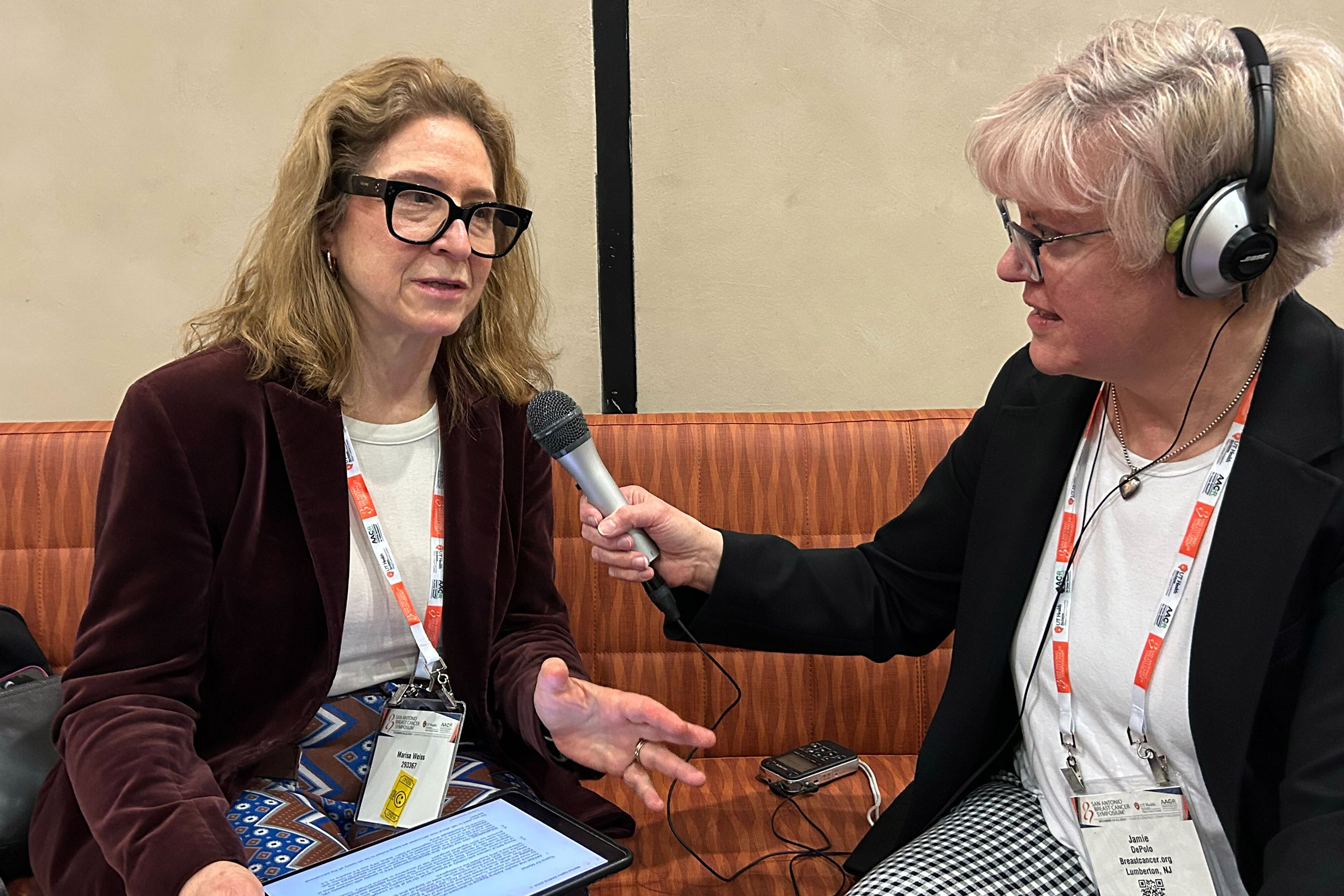
The 2025 San Antonio Breast Cancer Symposium featured four days filled with new research findings, poster presentations, and educational sessions. Marisa Weiss, MD, founder and chief medical officer of Breastcancer.org, offers her take on the top results.
Listen to the episode to hear Dr. Weiss explain:
- Sponsor Message
how giredestrant, a new oral SERD for early-stage, hormone receptor-positive breast cancer, may change practice
- Sponsor Message
a new use for Tukysa (chemical name: tucatinib) in metastatic HER2-positive disease
- Sponsor Message
the lifestyle factors that can affect breast cancer risk and steps people can take to keep their risk as low as possible
This podcast episode is made possible by Lilly.
Welcome to The Breastcancer.org Podcast, the podcast that brings you the latest information on breast cancer research, treatments, side effects, and survivorship issues through expert interviews, as well as personal stories from people affected by breast cancer. Here’s your host, Breastcancer.org Senior Editor, Jamie DePolo.
Jamie DePolo: Hi, I'm Jamie DePolo, senior editor at Breastcancer.org. I'm podcasting live from the 2025 San Antonio Breast Cancer Symposium. I'm delighted to be joined by Dr. Marisa Weiss, who is the founder and chief medical officer of Breastcancer.org. She’s been attending as many sessions as humanly possible at the conference and she’s going to share her picks for the studies and presentations that will likely have the biggest effect on patient care. Marisa, thank you so much for taking the time to do this.
Dr. Marisa Weiss: Thank you so much. To be with the fabulous Jamie DePolo, I'm honored. It’s wonderful to be here with you.
Jamie DePolo: Excellent. So, there was a study on giredestrant. It’s a new oral selective estrogen receptor, degrader or downgrader, whichever we want to call it, a SERD, downregulator, for early-stage hormone receptor positive breast cancer that could potentially change practice. So, can you talk to us a little bit about that?
Dr. Marisa Weiss: The whole area of anti-estrogen therapy is so important because two-thirds of women who have breast cancer have the kind of cancer that likes estrogen and progesterone and then grows when it’s around. So, an obvious strategy to treat the breast cancer, hopefully get rid of it, or get it in remission, is using anti-estrogen therapy. And this particular new medicine, giredestrant, is one of this new class of medicines. Part of this new class called SERDs, as you said, and it joins the family of anti-estrogen therapies. We have tamoxifen that can block the estrogen receptor and then we have an aromatase inhibitor, which reduces the amount of estrogen available in the body to actually get to the receptor and turn on the cells.
And then, the SERDs, the D for downregulator or degrader, actually sort of breaks down the door and breaks down the estrogen receptor so that it’s no longer functional. And this particular study was for people with early-stage breast cancer, and it was a phase III study, and it already had the safety data showing that women can take it safely without unusual side effects. And what this new medicine did was to lower the risk of an invasive recurrence or dying from breast cancer by about 30%, when compared to standard hormonal therapy like tamoxifen or like an aromatase inhibitor. And for women who are pre-menopausal, they’d be on a medicine that turns off the ovaries, puts them into menopause, and then slaps on an aromatase inhibitor.
And this new medicine outperformed those two forms of medicines, which are standard of care right now. It’s exciting to welcome a new type of medicine to the arsenal, the toolkit that we have, because this medicine can work against the breast cancers that already outsmarted tamoxifen and aromatase inhibitors, so we’re excited about this.
Jamie DePolo: That’s excellent. One thing I noticed in the presentation that I thought was kind of cool, maybe, because we know that a number of women, I'm not going to use a number but it’s a high percentage, stop taking early, hormonal therapy because of the side effects. And this particular medicine, while it did have similar side effects, it seemed like they were a little bit easier to tolerate because more women stayed on the medicine than they did on tamoxifen or an aromatase inhibitor.
Dr. Marisa Weiss: That’s absolutely right. I mean, even though most women have breast cancers that like hormones, many of the women for whom these medicines are prescribed can't get along with them. Like these medicines are hard to deal with and it’s so personal, it’s so individual. One person’s experience does not necessarily predict for someone else’s experience. But when you talk to people who have breast cancer and are taking these medicines, many of them report that the medicine is, like, messing up their life. They don’t feel the same quality of life. Like they have hot flashes, they can't sleep well, or they have muscle and joint discomfort. They have vaginal dryness. They’ve lost their libido. They just don’t feel like themselves or their go-go juice got up and gone, you know?
And so, what they found was that even though this medicine seemed to be more effective than standard of care, tamoxifen and aromatase inhibitors, it had less significant side effects. Similar kind of side effects, but they weren’t as intense or they didn’t interfere with a person’s quality of life in the same way, which is hopeful because maybe if this is better-tolerated more people can stay on it and lead the life that they want to and get the benefit from the medicine. The benefit being to protect your life.
Jamie DePolo: Perfect. Thank you.
So, now for HER2-positive metastatic disease, we heard from Dr. Erika Hamilton that adding Tukysa or tucatinib, as most doctors call it by its chemical name, to the maintenance therapy, which you would take after Herceptin, Perjeta, and chemo, the maintenance therapy of just Herceptin and Perjeta, controlled the cancer better. So, do you want to talk about that a little bit because that’s kind of exciting too?
Dr. Marisa Weiss: Yeah. Well, you know, for women who have HER2-positive breast cancer, they’re looking at being put on chemotherapy together with anti-HER2 therapies and going one cycle after another, after another, and then they stop, re-evaluate, usually have surgery at that point. But then after surgery, they’re put back on the anti-HER2 therapies. And depending on whether or not they had a complete response to their upfront chemo, anti-HER2 therapy as determined by the results of surgery or not, they maybe have an adjustment in their treatment plan. But for anyone who has been through chemo-anti-HER2 therapy and had their surgery, they still all go on a maintenance plan generally. And traditionally that’s been Herceptin and Perjeta.
And this study looked at adding tucatinib, which is a pill form of anti-HER2 therapy, to the mix of Herceptin and Perjeta after they finished their upfront chemotherapy. And that combination helped people stay well, freer of progression for a significantly longer period of time than just the Herceptin and Perjeta alone. So this is a medicine that is definitely worth talking to your doctor about and saying, you know, does this new medicine, tucatinib…actually this medicine has been around for a while, but this study is new and it tells us a new way that we can use this study to help protect more people who have HER2 positive disease.
And what’s especially meaningful is that this part of treatment is chemotherapy-free. So, this is after you’ve graduated from the course of chemo together with anti-HER2 therapy. Again, you’ve had your surgery, you may have had radiation, and any other form of local treatment, and then tucatinib is then added in pill form along with Herceptin and Perjeta. And those other medicines are usually given IV, intravenously. For many people, this means fewer long clinical visits if you can take it by pill form, you know, take it at home. And a treatment plan that fits more comfortably into your everyday life. It’s an approach that may help keep the cancer controlled longer while you move on and begin to settle back into the life that you wanted to have.
Of course, all those transitions from chemo, anti-HER2 therapy, to surgery, to other forms of treatment, to afterwards, these are all major adjustments. We’re not trying to make it seem like these easy steps to take. They are hard. And I'm a breast cancer survivor myself beyond being the chief medical officer and founder of Breastcancer.org, and I know it is a bitch that these steps that we’re taking, that we’re asking people to take, that we’re recommending that people do, are really rough. But it’s good to know that at least they’re likely to give you an important benefit that you need to protect your life.
Jamie DePolo: Well, and I think it’s nice too, especially for people with metastatic disease, I mean, they know they’re going to be in treatment for the rest of their lives, you can get Herceptin and Perjeta as an injection and then if you can take tucatinib as a pill, too. So, your maintenance therapy…this can kind of keep you out of the chemo chair and keep you out from the infusion chair longer, which is nice. So, that’s cool.
So, there was also a very interesting educational session on hormone replacement therapy, which seems to be having a moment in the media, social media. Everybody seems to be talking about it. It’s also called menopausal therapy and the recent decision to remove the black box warning from all forms of HRT and the state of the research. So, I know you were in that session. I saw you there. What should we take away from that if anything? I know there weren’t a lot of definitive answers, but it seemed like there was a lot of discussion.
Dr. Marisa Weiss: Right. I mean, this has been a bumpy road for anyone who’s had breast cancer, because you listen to the media and they say, good news, everybody. The FDA took off the black box warning off of menopausal hormonal therapy…that’s what they’re calling it now. Which is very different by the way than hormonal therapy against breast cancer, which is anti-estrogen therapy that we were just talking about.
Okay. So, we turn on the TV, listen to the radio, look in the paper, look in the magazines. All the celebrities are talking about it on social media platforms, I'm going for my menopausal hormonal therapy.
And once again, we as breast cancer survivors feel like we’re out of luck on this one, okay? Yet, we’re the ones that are experiencing some of the worst menopausal-related side effects. Either because we went through menopause naturally and we can't take medicine that will help us with trouble sleeping, with dry vagina, with loss of libido, with feeling more moody, for feeling more down and out, for being concerned about your bone health, and your heart health. Everything, right? And you feel like, oh, thanks a lot. Great that you guys can have access to this, but what about us? So, that’s what this session was all about.
Dr. Lisa Larken, who’s a colleague and friend of mine, and also a breast cancer survivor, got up there and talked about it. And basically, this bottom line is, that women who’ve never had breast cancer are now lining up for menopausal hormonal therapy, trying to get it from their doctor, their gynecologist, their primary care, who may or may not have experience prescribing it. And they’re going on and they’re doing that whole thing. But for us as breast cancer survivors we still don’t know if it’s safe.
We do know that vaginal estrogens are okay to use. And that can help you with vaginal dryness. It means less discomfort with sexual activity, which might mean if it’s not uncomfortable, you may want to be able to have more sex. Also, you might be able to lubricate better. You may be able to respond more to stimulation, and you may have fewer urinary tract infections or irritations. You know, the other thing is, just wearing a pair of jeans that can put pressure on the vulvar area, the outside of the vagina area, can be uncomfortable. So, the idea of using vaginal estrogens on the inside of the vagina and on the outside of the vagina is available to women who have had breast cancer, even those who have had hormone receptor-positive breast cancer. The kind of breast cancer that likes estrogen and progesterone and all that stuff.
But, when it comes to taking these medicines by pill or other forms that go in your body and are what we call systemically absorbed, like go to your whole system, still not really known to be safe. So, there’s still effectively a black box on those medicines for us, which stinks. Because we also want to have relief from natural onset menopause or early onset menopause where you're thrown into menopause by chemotherapy or you're on an ovarian function suppressing regimen, like Zoladex or something like that or another mechanism. Maybe you’ve had your ovaries removed, you know, the early onset of menopause, which can cause really severe symptoms that you want to have some relief.
So, right now for women who’ve had breast cancer, we do not know if hormone replacement therapy or menopausal hormonal therapy using estrogen, estrogen and progestin together if you have a uterus, or testosterone, given by pill, with systemic absorption, or using gels and things like that, or patches. We don’t know that that is safe. The American Society of Clinical Oncology also came out and said, we’re not confident that it’s safe to use those things right now. We are in a data-free zone, meaning we don’t have enough information to tell you if it’s good or not, if it’s okay or not, if it’s safe enough.
But there are other medicines that are available today that weren’t there before that can help out. For example, there are the vaginal moisturizers. Just like, I don’t know about you, but I have like ChapStick in every pocket of my coat, in my pocketbook, in my desk, wherever I am, next to my bed. I'm always putting it on. Well, just like your upper lips, the lips on your mouth are getting dry, well your vagina lips, the outside, the labia minora and majora, the small and bigger ones down there, can get dry. The vagina can get dry. So, it’s thirsty for a moisturizer. So, there’s the moisturization that you want to maintain your vagina, make it happy, make it wet, make it slippery. It gets thicker over time, maybe.
And also, using the appropriate pH, which is like the acid base characteristic of like…lubricant is important to use. Like Uberlube. Überlube works really well and it’s at the right acid base balance for the vagina. Some of those moisturizers out there that you see are not at the same pH level as the vagina. So you start using lubricants all over you, all over your partner, all over your hands, whatever is going down there it’s got to be wet and slippery, okay? To make the whole thing work out. But you want it to be as friendly to the vagina as possible and Überlube is one of those things that people like to use that does work. You need to have a lot of it, and you need to use it again and again.
And you know, stay tuned to Breastcancer.org for any updates that come out about the management of menopausal symptoms. You know, how do you manage insomnia? It’s so important. How do you stay physically active and use your muscles and your joints when you know that’s really healthy? How do you feel good about yourself? How do you manage hair that might be falling out because you're on these anti-estrogen therapies? Topical minoxidil. It’s now generic, I use it, 5% solution, applied with an eyedropper twice, three times a day, helps. Some people take the pill, minoxidil pill, that helps. You might get some extra hair you might not want around your body, but you’ve got to take care of that. A lot of people who feel happy about what’s on their head and their full head of hair are willing to take the package deal on that one.
Jamie DePolo: Okay. Thank you. And then, there was also a session on genetic testing that you said was interesting. So, could you share the highlights from that?
Dr. Marisa Weiss: Well, here’s the thing. Assessing your risk of getting breast cancer is so important for anyone who’s been diagnosed. And there are many different factors that influence your risk of getting it and if you’ve been diagnosed with breast cancer understanding your risk of getting recurrence or having a new breast cancer in the future, and it also helps your family members understand what the risk might be by their getting the information about, you know, family history, and all that stuff. One of the key elements to assessing risk is genetic testing.
Did you inherit a gene abnormality that may put you at elevated risk? Did you inherit from your mother’s side, father’s side? It’s always good to sort of get the family history together and organize it on paper. Not an easy task because you're asking family members about something that they don’t really want to talk about. Been there, okay? I've had genetic testing four times because one of the things about risk assessment is that it changes over time as more people in your family may be diagnosed with this kind of problem, that kind of problem. I like to say, there should be a role for genetic testing before Thanksgiving because there are…
Not only that. No, because I've got the boring family members and the ones who’ve got no sense of humor. They need a genetic test, you know, to figure out what’s going on in that part of the family that explains that personality deficit defect, and don’t sit them next to me, please.
In any case, when it comes to genetic testing, it is really important that you get the right panel, which means the profile, the list of gene changes that are appropriate for your situation. Most of the panels today are large and because so many more people are getting genetic testing, it takes longer to get the results. It used to be that you would always meet with a genetic counselor before you would send off a sample. Now, because there’s a shortage of genetic counselors, you might get genetic testing and only meet up with a genetic counselor if they find something.
Now, there are different kinds of things that they might find. They might find a genetic abnormality that we already know to be what we call pathogenic or deleterious, meaning that it’s associated with a high risk of getting cancer, like BRCA1, BRCA2, PALB2. Those are single inherited genetic abnormalities that have been around for thousands of years that are associated with a high risk of getting breast cancer in the course of your lifetime. Not just one breast cancer, but another one in the future. So, when they find that out, they want to take certain steps to lower the risk of getting breast cancer again in the future. But also those genes are associated with a high risk of other types of related cancers, like ovarian cancer, peritoneal cancer. That’s a cancer of the lining of the belly wall or the fallopian tube.
Also, pancreatic cancer can run in some families. Like BRCA2 is associated with high risk of pancreatic cancer, breast cancer in men. There’s a risk of prostate cancer, that’s right, melanoma. So, these cancer genes don’t just tell us about breast cancer risk, they also help us identify new forms of treatments that work extra well in women and men who have breast cancers that are related to a BRCA gene or a PALB2 gene abnormality.
And then, there’s a whole group of moderate-risk gene abnormalities like CHEK2 or ATM. Those are gene abnormalities that partly contribute to a moderate risk of getting breast and other related cancers. But one of the most important take-home messages from the conference is to make sure that if you do get a genetic test and it comes back and shows an abnormality, that you talk to a genetic counselor to get personalized guidance on how to manage that risk. Okay?
When you get that test result back, even though it can make you feel very upset as soon as you read the report, you’ve got time. You’ve got time to meet up with a genetic counselor to get the guidance that you need because there’s a whole huge range of genetic alterations that are within the bucket of BRCA1, BRCA2, PALB2, and while many of them are associated with a high risk of getting breast cancer, not just once but another time, as well as those other cancers that we discussed, but sometimes they’re associated with a lower risk, like a moderate risk whereby you might not need to take the same big steps.
You might get a genetic test result that says that you have a VUS, which stands for a variant of unknown significance. We know a lot about different genetic alterations and their associated risk, but there’s some genetic alterations that we don’t yet know if they’re meaningful or not. They may just be showing up on the test result. They almost always report them, even if they have no clinical meaning because they’re covering their rear end. You know, because they don’t want to withhold information that maybe one day is useful.
Now, my family just by example, has had VUSes that eventually were reclassified as benign after they had additional research, you know? And when I went to my doctor to discuss my genetic test results, she would go on Google herself and look up that genetic test because the knowledge about genetic information, the genes that we inherit from our parents, is evolving so quickly. Even the queen of genetic testing will look on Google. So just know that this is not an emergency. If you have a genetic test result that shows a genetic alteration, make sure that you get guidance from a genetic counselor that’s smart in their field of breast cancer before you take any steps to lower your risk, especially those steps that are irreversible, like prophylactic mastectomies. You’d only want to do that if you need to do it. If you need it, you want it, but if you don’t need it, you don’t want it.
Jamie DePolo: Okay. Thank you so much. And then finally, there were a few sessions on lifestyle factors and risk, which I know is a topic that’s very important to you, including alcohol, obesity, and exercise. So, what’s the takeaway there? What’s your advice for folks? Don’t drink, exercise, and lose weight?
Dr. Marisa Weiss: Okay. Well, this is…if you’ve had breast cancer like I have, staying healthy is an every-day commitment. It’s not just every day. It’s throughout each day to be good and stick to the plan, right? But no one’s perfect. So, as it turns out, more breast cancers are related to lifestyle. How you lead your life. What goes in on or around you, how much you weigh, how much extra weight you might be carrying around. How active or inactive you are, as well as alcohol consumption, smoking, being socially isolated, the type of food you eat. And so, when it comes to lifestyle, we know that that’s something we can modify, we change it in an everyday way, but we can't change our genes right now.
So, being committed to staying healthy over time means a commitment to a healthy lifestyle, which means staying physically active, shooting for 150 minutes of moderate to vigorous exercise per week, mix it up, make it social so it’s fun, it’s less of a chore. There’s all kinds of apps online. We at Breastcancer.org have a number of different videos that are free to you to use. And then making sure you add in two to three times a week of strength training. So using weights to make sure that your arms, your shoulders, your belly, your core muscles are strong. That’s to keep your bones strong. That’s really important. If you're really short on time, instead of doing 150 minutes of moderate to vigorous exercise a week, you could do 75 minutes of vigorous exercise each week but that means that you’ve got to have good balance so you're not going to fall and not going to put yourself at risk for injuring yourself.
And then it also means getting enough sleep each night. What I mean by that, making sure to get at least five to seven hours, up to nine hours. Over nine hours is actually too much sleep they think. It’s been correlated with that. But if you're getting nine hours and you need it, go girl, go guy, do it. Okay? And when it comes to problems with sleeping, it’s a chronic problem for all Americans, but particularly for those of us with breast cancer who have been on those medicines, or in menopause, or on those medicines. As it turns out, cognitive behavioral therapy-I, standing for insomnia, is the most effective way to address sleep issues. And that can include stimulus control, like avoiding bright lights from your computer, from your phone, from apps, from the TV, an hour or so from when you're going to go to sleep, like just chill out. Grab that boring book or read some recipes in dim light. Like try to put yourself to bed. The way I think of it is, think of yourself as a newborn baby. You want to put yourself on a schedule where you are waking up at the same time, going to sleep at the same time. You are trying to eat at the same time, exercising earlier in the day, hopefully you get outside. Okay?
Also important in lifestyle is staying socially connected. Even if you're a loner. Like I love being alone and I do a lot on my own. I've had to be my own champion throughout a lot of my life, you know? But it’s still important to stay socially connected. You know, not to work alone, live alone, eat alone, dance alone, drink alone, all that stuff. Try to mix it up so that you can be socially connected. You can get outside of your own head and reconnect.
Smoking cessation. Obviously, smoking is not good for us. Everyone who smokes knows that. I take care of a lot of women for whom their cigarettes are their best friends. It’s where they go when they're upset. They pull out a cigarette and they smoke. It’s how they calm down. I totally get it, but just so you know, smoking, if it was easy to stop, you would’ve stopped a long time ago, but it’s not easy. But there are definitely new tools today that are very effective, that help you cut back on smoking and hopefully stop smoking. And if there are other incentives like you can't go over your kid’s house because the grandkids are there, they won't let you smoke. That’s an incentive. If you’ve been diagnosed with breast cancer, try to use that moment in your life to make some healthy changes.
And cutting back on alcohol use, you know. So, less is best. But hey, you’ve got to have fun. And you’ve got to go out. You want to enjoy a meal with good friends and the wine comes out. I would start drinking, like, seltzer with, like, a flavored seltzer, like put a mint in it. Today we had lunch together, I put seltzer, a little bit of cranberry juice, make it a little bit pink, with a lime and a little bit of mint. If you put it in a wine glass, it dresses it up. Quench your thirst with a non-alcoholic beverage. And if you are going to have an alcoholic beverage don’t let them fill the whole glass up, you know, five ounces is considered one glass of wine. Then after that glass of wine…if you're drinking the wine with food, you tend to drink it much slower than if you were at a party. It’s a cocktail party and you walk around with one glass of wine. And it is true that today more and more people are not drinking alcohol and drinking less, and we have many more non-alcoholic delicious beverages that are yummy, okay?
And then, there’s the big lifestyle factor, which is weight. The extra weight causes a bunch of problems. The extra weight makes extra hormones, which can overstimulate the cells in your body, including breast cells. The extra weight causes inflammation, which is an irritant. It’s like someone talking to you when you're trying to sleep. You know, the cells are trying to, like, do their business and this inflammatory process in the body is just, like, yacking in their ear, not good. Also, when you're carrying a lot of extra weight around you tend to be less physically active, which is not good, of course. You tend to be eating foods that are not very healthy for you, not good. Try to stick with fresh foods and fresh drinks as well.
And you want to avoid all those irresistible foods that have fat, sugar, salt, and a crunch to them that are usually ultra processed. We also heard at San Antonio that people who consume the processed, ultra processed foods with artificial ingredients and preservatives and stuff like that had more medical problems than those who didn’t and a higher risk of breast cancer and breast cancer recurrence. So, that’s not good.
And then, we do have the GLP-1s. This new class of medicines that help people lose weight. And how does it do it? It cuts back on your appetite. It makes you feel full faster. The food noise is sort of gone. You can lose weight. And these medicines appear to be safe in people who have breast cancer. There are even studies that are giving these medicines to people who are going through treatment to try to reduce the side effects of treatment and also to help you while you're on the anti-estrogen therapies avoid the weight gain that some women experience while on those medicines that interfere with people sticking to those medicines because that’s a side effect that nobody I've ever known or have taken care of in 30 years want.
Jamie DePolo: Absolutely not.
Dr. Weiss, thank you so much. This has been so helpful, and I really appreciate all your time.
Dr. Marisa Weiss: Well, I am thrilled to be working with you, the queen, Jamie DePolo, we all love you and you do a fabulous job. So, thank you so much.
Jamie DePolo: Ah, thank you.
Thank you for listening to The Breastcancer.org Podcast. Please subscribe on Apple Podcasts, Google Podcasts on Android, Spotify, or wherever you listen to podcasts. To share your thoughts about this or any episode, email us at podcast@breastcancer.org or leave feedback on the podcast episode landing page on our website. And remember, you can find out a lot more information about breast cancer at Breastcancer.org and you can connect with thousands of people affected by breast cancer by joining our online community.

Dr. Weiss is regarded as a visionary advocate for her innovative and steadfast approach to informing people how to protect their breast health and overcome the challenges of breast cancer. Dr. Weiss currently practices at Paoli Hospital and Lankenau Medical Center, where she serves as director of breast radiation oncology and director of breast health outreach. Learn more.

This podcast episode is made possible by Lilly.
Your donation goes directly to what you read, hear, and see on Breastcancer.org.