Key Takeaways From SABCS 2025


More than 11,000 scientists, healthcare professionals, and advocates gathered at the 2025 San Antonio Breast Cancer Symposium to exchange ideas about the latest developments in breast cancer.
Special sessions this year focused on breast cancer in younger women, the interaction between breast cancer treatment and lifestyle factors such as nutrition, physical activity, and sexual health, as well as strategies to reduce obesity-related breast cancer risk.
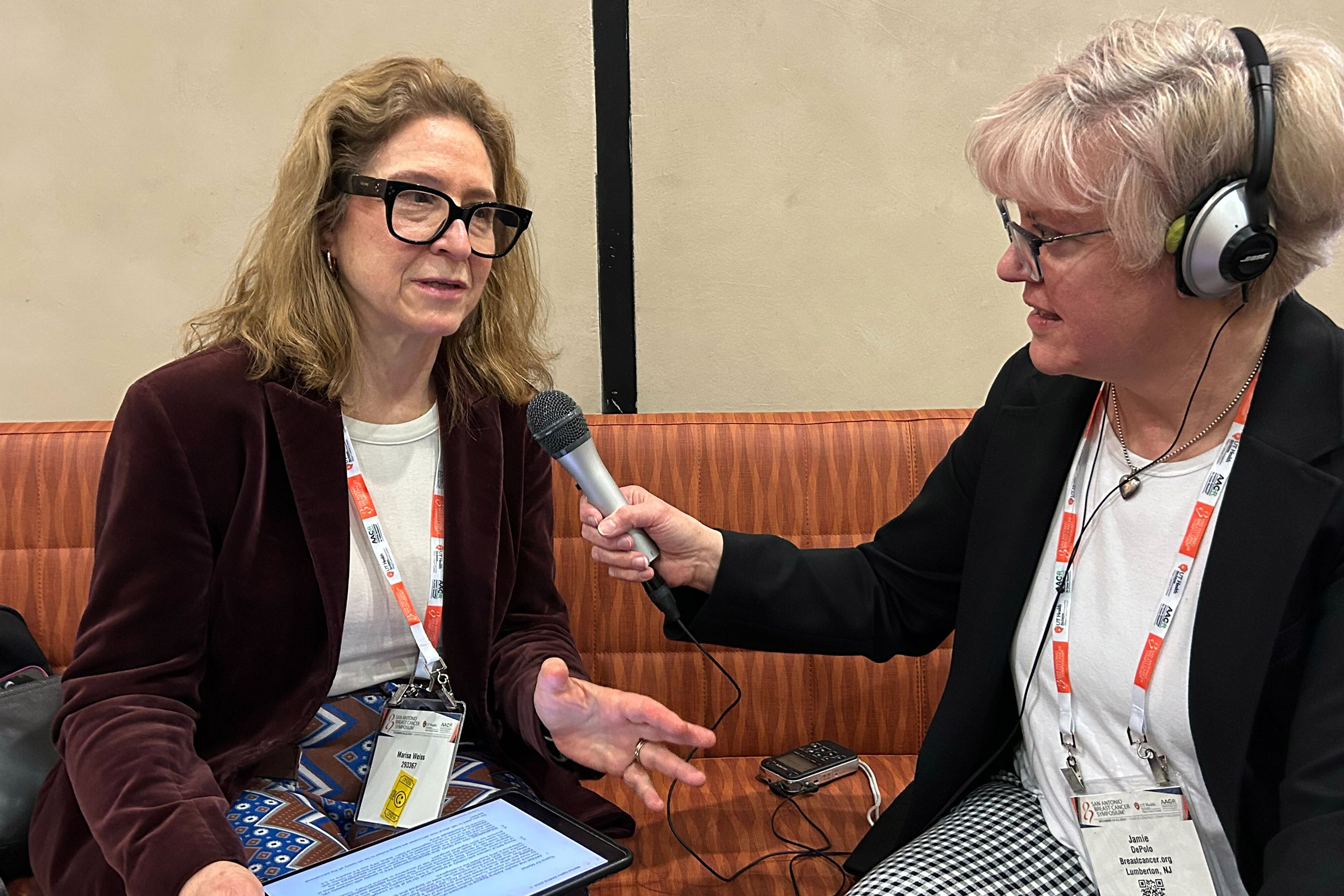
Marisa Weiss, MD, radiation oncologist and founder and chief medical officer of Breastcancer.org, explains the research presented at the 2025 San Antonio Breast Cancer Symposium that has the most immediate implications for people diagnosed with breast cancer.
Oral SERD may be new standard of care for early-stage HR-positive breast cancer
After surgery, people diagnosed with early-stage hormone receptor-positive breast cancer who took giredestrant, a new oral selective estrogen receptor degrader/downregulator (SERD), lived longer without the cancer coming back (progression-free survival), than people who took tamoxifen or an aromatase inhibitor.
Learn more about the lidERA study on giredestrant.
Listen to a podcast with Aditya Bardia, MD, MPH, FASCO, professor of medicine at the David Geffen School of Medicine at UCLA, who presented the research on giredestrant.

Giredestrant Promising New Treatment For Early-Stage HR-Positive Breast Cancer
With guest Aditya Bardia, MD, MPH
Dec 10, 2025Research
Adding Tukysa to Herceptin and Perjeta improves outcomes in metastatic HER2-positive disease
Currently, people with metastatic HER2-positive breast cancer receive initial treatment with chemotherapy, Herceptin (chemical name: trastuzumab) and Perjeta (chemical name: pertuzumab). After that, they continue to receive maintenance therapy with Herceptin and Perjeta for as long as the combination is effective.
Now, results from the HER2CLIMB-05 trial show that adding Tukysa (chemical name: tucatinib) to Herceptin and Perjeta maintenance therapy controls cancer growth better than Herceptin and Perjeta alone. Progression-free survival — how long the people lived without the cancer growing — was about 25 months for people receiving Tukysa, Herceptin, and Perjeta, compared to about 16 months for people receiving only Herceptin and Perjeta.
“This is good for patients — it gives them more options,” said Kate Lathrop, MD, associate professor of medical oncology and hematology at UT Health San Antonio and SABCS program director, during a media briefing. “This is a non-chemo regimen. Tucatinib is a pill and [Herceptin and Perjeta] can be given as an injection, so it keeps them out of the infusion chair and helps optimize quality of life.”
Learn more about the results of the HER2CLIMB-05 study.
TNBC vaccine phase I trial has promising final results
Results from an early trial testing the safety and dosing of a vaccine to prevent triple-negative breast cancer showed the vaccine caused an immune response in 74% of the women in the study. The vaccine also didn’t cause any serious side effects, with redness and swelling at the injection site being the most common. After these positive results, the next steps will be a larger phase II trial held at multiple sites around the United States.
Justin Johnson, inflammation and immunity researcher at the Cleveland Clinic, talks about the results on this episode of The Breastcancer.org Podcast.

Final Results From Early Trials on a Vaccine to Prevent TNBC
With guest Justin Johnson, PhD
Dec 11, 2025Research
Can you use HRT with a history of breast cancer? Maybe, but it’s complicated
On social media, hormone replacement therapy (HRT) — also known as menopause hormone therapy (MHT) — is touted as an anti-aging miracle. But using HRT does have risks, especially for people with a history of breast cancer or who are at high risk of developing the disease.
Listen to a podcast with Tara Sanft, MD, medical oncologist at Yale Cancer Center, who moderated a session outlining all the research on HRT. She explains why HRT decisions need to be highly nuanced and individualized, taking into account each person’s risk or risk of recurrence, subtype of breast cancer, age, and other factors.

Making HRT Decisions With a History of Breast Cancer
With guest Tara Sanft, MD
Dec 10, 2025Side Effects
Acupuncture effectively treats chemo brain
More than 40% of people who receive breast cancer treatment experience brain fog, also known as chemo brain. Unfortunately, there are few effective treatments for chemo brain. New research found that acupuncture helped ease these thinking and memory problems and caused few side effects.
Jun Mao, MD, MSCE, chief of Integrative Medicine and Wellness Service at the Memorial Sloan Kettering Cancer Center, talks about the results of his team’s research on The Breastcancer.org Podcast.

Dato-DXd may help treat leptomeningeal disease
A very small study of 10 people suggests that Dato-DXd, an antibody-drug conjugate, may effectively treat leptomeningeal HER2-negative breast cancer. Leptomeningeal disease is cancer that has spread to the fluid around the spinal cord and the brain.
All 10 people in the study received Dato-DXd. After about eight months of follow-up, the amount of time that the people lived without the cancer growing (also known as progression-free survival) was about four months. Three people in the group had never received an antibody-drug conjugate prior to the study, and seven had. The three people who hadn’t previously received an antibody-drug conjugate had longer progression-free survival than those who had (5.9 versus 1.4 months).
Seven people in the group had neurological symptoms, such as confusion, problems with balance, or mood swings, caused by leptomeningeal disease. Of those, five had their symptoms improve after taking Dato-DXd.
Radiation and Keytruda before surgery boosts immune cells in some high-risk breast cancers
Hormone receptor-positive HER2-negative node-positive breast cancer tumors treated with a boost dose of radiation and the immunotherapy medicine Keytruda (chemical name: pembrolizumab) before surgery had higher levels of immune cells two weeks after the treatments. This could make Keytruda more effective in this type of breast cancer.
“The study suggests that radiation could be used in a new way — to prime the immune system and enhance the effects of immunotherapy in HR-positive, HER2-negative breast cancer,” said Gaorav Gupta, MD, PhD, at a media briefing. Gupta is associate professor of radiation oncology and co-leader of the Breast Cancer Research Program at the University of North Carolina Lineberger Comprehensive Cancer Center. “We found early evidence that [this treatment combination] can boost immune activity and may improve tumor clearance before surgery. These results lay the groundwork for future clinical trials exploring this promising approach to improve long-term outcomes for breast cancer patients.”
New areas of research for lobular breast cancer
Invasive lobular breast cancer (ILC) tends to get less attention than invasive ductal breast cancer (IDC), but that needs to change, said researchers in a special session on ILC, given that it makes up 10–15% of all diagnoses. Lobular breast cancer is difficult to diagnose because it isn’t as easy to spot as IDC, and it’s more difficult to monitor during treatment, says Marleen Kok, MD, PhD, medical oncologist and group leader at the Netherlands Cancer Institute.
While the amount of research on ILC has grown dramatically in the last 10 years, the number of clinical trials has remained low. “With trials specific to lobular breast cancer, we’re just at the start,” said Kok. ILC research currently under way includes studies focused on the ROS1 protein (which is commonly overproduced in ILC and which the tumors rely on to grow), and the ERBB2 mutation (which causes the cancer to grow). “The ERBB2 mutation, which is not typically tested in breast cancer, is more common in [ILC], so we should study more and more of those features so we can come up with clever new treatments for lobular breast cancer patients.”
People with breast cancer and caregivers need more information about recurrence risk
Many people completing breast cancer treatment do not receive a survivorship care plan or other information about their follow-up care, a gap that advocate Megan-Claire Chase and her colleagues sought to address with their research, which Chase presented in a poster at the conference. The survey focused on what patients and caregivers understand about the risk of recurrence, as well as areas where they want more information.
“What should we think about as we get further out in survivorship and that fear of recurrence?” says Chase, who had a lobular breast cancer diagnosis. “What we’re discovering is that...a lot of our oncology team, once you get to that five-year mark, they kind of drop you, and then you're given to your primary care provider and there's really no additional direction.” At that point, she explains, “I don’t have an oncologist. Where are they to tell me, ‘Here's what you should be looking for as you have that fear of recurrence’?”

“We Need More Education About the Risk of Recurrence”
With guest Megan-Claire Chase
Dec 10, 2025Breast Cancer Risk
How do GLP-1s affect breast cancer treatment for people with obesity?
Researchers are still in the early stages of investigating the effects of GLP-1s on people with breast cancer and obesity but have found some promising leads. New GLP-1 studies presented in a session show that GLP-1s may reduce chemotherapy side effects, like fatigue, anemia, neuropathy, and nausea and vomiting, but may increase hormonal therapy side effects like hot flashes, joint pain, and endometrial cancer. Another study found that the weight loss drugs appear to reduce all-cause mortality (dying from any cause) for those on hormonal therapy and may improve five-year overall survival for people with ductal carcinoma in situ (DCIS) on hormonal therapy. But this research is preliminary, and the experts say more high-quality studies are needed to confirm these results.
HRT seems safe for post-menopausal women with a BRCA mutation
Many young people with a BRCA mutation have surgery to remove their ovaries and fallopian tubes (salpingo-oophorectomy) to lower their cancer risk: The procedure reduces the risk of dying, from any cause, for BRCA carriers by 64%. But it also causes early menopause — and all the associated symptoms — and increases the risk of developing other chronic diseases.
Joanne Kotsopoulos, PhD, and her research team at Toronto’s Women’s College Hospital wanted to see if HRT, also known as menopause hormone therapy or MHT, would increase breast cancer risk in people with BRCA mutations. Although MHT can effectively treat menopausal symptoms, doctors tend not to prescribe MHT to people who have BRCA mutations for fear of raising their cancer risk.
The study followed women who had BRCA1 and BRCA2 mutations, had gone through menopause (mostly induced by surgery), and had not had prophylactic mastectomy or a history of cancer, for about five years. Half of the 1,352 women took MHT, and half did not. More women in the group that did not take the MHT developed breast cancer (128 cases) than in the group that did (87 cases). Not only did MHT not increase breast cancer risk — it actually seemed to lower it.
“We cannot simply recommend a drastic surgery like oophorectomy for young women without offering a way for them to manage the well-established short- and long-term outcomes of surgical menopause,” said Kotsopoulos in a press release. “I believe we should educate patients and their health care providers on how we can safely balance the risks and benefits of MHT use to ensure longevity and improve quality-of-life.”
Young survivors have better quality of life with online support tool
Rates of breast cancer in women ages 15 to 39 have risen about 0.6% each year between 1975 and 2022. Research suggests that young people with breast cancer are more likely to have emotional and medical challenges after a diagnosis than older people. An interactive online tool improved both overall and cancer-specific quality of life in young survivors.
Ann Partridge, MD, MPH, professor of medicine at Harvard Medical School and vice chair of medical oncology and chief clinical strategy officer at the Dana-Farber Cancer Institute, explains the results of a study on the Young, Empowered & Strong (YES) mHealth tool on The Breastcancer.org Podcast.

Interactive Online Tool Improves Quality of Life in Young Breast Cancer Survivors
With guest Ann Partridge, MD, MPH
Dec 12, 2025Life With or After Cancer
Alcohol raises breast cancer risk, but binge drinking is a unique risk factor
Research shows that there may be no safe level of alcohol intake for breast cancer risk: Even having fewer than three drinks per week seems to raise the risk of breast cancer. And although alcohol raises breast cancer risk in both pre-menopausal and post-menopausal women, the risk is higher in post-menopausal women.
Different patterns of drinking affect breast cancer risk, though, emerging research shows. Binge drinking — having four or more drinks in a short time period, at least once per month — may be especially harmful, said Julie Palmer, ScD, a cancer epidemiologist at Boston University, and is a unique risk factor separate from regular drinking. An increase in binge drinking among women in their 30s and 40s could partly explain a rise in early-onset breast cancer, but there isn’t enough research to make that connection yet, said Mary Beth Terry, PhD, an epidemiologist at Columbia University. These were some of the takeaways from a session on drinking's effect on breast cancer risk.
Can medicine lower breast cancer risk from obesity?
Research shows that obesity is a risk factor for breast cancer, but the risk isn’t the same for everyone. There’s strong evidence showing that post-menopausal women with obesity have a higher risk of estrogen receptor-positive breast cancer. This is likely because fat tissue that releases estrogen is a major source of the hormone in post-menopausal women. Early research suggests that obesity may also raise estrogen levels in women with BRCA1 and BRCA2 mutations. Lowering estrogen levels decreases their breast cancer risk, but many young women don’t want to be on anti-estrogen therapy for decades, said Kristy Brown, PhD, a cancer and metabolism researcher at the University of Kansas Medical Center.
Lowering estrogen release from fat may be a way to reduce that risk. Metformin, a drug used to treat high blood sugar levels in people with diabetes, may be able to do this by lowering levels of aromatase, an enzyme that helps make estrogen. Research in breast tissue samples from women with BRCA1 and BRCA2 mutations shows this may decrease DNA damage. But research on metformin for breast cancer is mixed overall and may only benefit certain subgroups; more research is needed to know who, if anyone, it may benefit. Researchers are also looking at the use of GLP-1s in mice with both obesity and BRCA mutations to see if it can reduce weight and DNA damage.
Breast cancer in young people may have unique biology
Rates of breast cancer among people 45 and younger are increasing by 1.4% per year and researchers estimate that there will be nearly 3 million cases in people younger than 50 by 2040. In many cases, young-onset breast cancer also has different genetic mutations and gene expression than breast cancer diagnosed in older people. At the same time, being diagnosed with breast cancer at a young age forces people to make big decisions about fertility, child-bearing, quality of life, and future risk in a short period of time. As advocate Christine Hodgdon commented in a special session on the topic, “Shared decision-making is crucial for young people with any type of cancer.”
Addressing skin side effects from breast cancer treatment
While many people know about the skin issues caused by radiation, almost any type of therapy can affect the skin, the largest organ in the body. An educational session focused on the body image, hair loss, and skin side effects caused by breast cancer treatment.
Ian Tattersall, MD, PhD, an oncodermatologist at the NYU Langone Perlmutter Cancer Center, summarizes his talk on some of the most common skin issues and how to treat them on The Breastcancer.org Podcast.

Addressing the Skin Side Effects of Breast Cancer Treatment
With guest Ian Tattersall, MD, PhD
Dec 12, 2025Side Effects
Racial, socioeconomic, and geographical disparities persist in breast cancer care
Disparities in breast cancer care continue to be a major barrier to people getting the best possible outcomes from their treatment. A poster session highlighted new research on disparities in cancer care, shedding light on where interventions are needed to make care more equitable. Some of the important findings:
Black and Hispanic women with metastatic estrogen receptor-positive, HER2-negative breast cancer have a longer wait time until they start treatment, even after controlling for socioeconomic factors.
Black and Hispanic women — as well as those who have Medicaid, Medicare, or no insurance — with early-stage, high-risk triple-negative breast cancer are less likely to receive neoadjuvant immunotherapy and chemo.
Black women with metastatic triple-negative breast cancer are less likely to receive novel therapies like immunotherapy, PARP inhibitors, and antibody-drug conjugates than white women. Among Black women treated with the novel therapies, survival is worse than it is for white women.
Nearly 73% of drugs approved by the FDA for breast cancer from 2015 to 2025 had clinical trials with fewer than half of participants coming from racial or ethnic minority groups.
Women with breast cancer in rural areas are more likely to visit the emergency department within a 12-month period, have fair or poor health, and have work limitations due to their health. Three factors contributed to this: not using telemedicine in the past year, having anxiety or depression, and being on Medicaid.
New liquid biopsy test may help with treatment decisions
Liquid biopsies can detect mutated DNA shed from tumors (circulating tumor DNA, or ctDNA) that are in the blood of people with cancer. And they can also detect very small amounts of cancer cells that remain in the body after treatment. These remaining cells are called minimal residual disease (MRD), and they can lead to recurrence. A new liquid biopsy test out of Stanford University is much more sensitive than previous tests — enough that it should be able to detect the majority of MRD cases, said Maximilian Diehn, MD, PhD, a radiation oncologist at Stanford University. If more data confirms this for breast cancer, the test could help doctors decide who would benefit from adjuvant therapy to lower the risk of recurrence. On the flip side, it could help identify people who don’t have MRD so they don’t receive unneeded adjuvant therapy.
New AI models aim to predict recurrence risk as well as genomic testing
New AI models may one day be a cheaper and just as accurate alternative to genomic tests for predicting if some breast cancers will come back within five years. Current genomic tests like Oncotype DX evaluate tumor samples to create recurrence scores, which doctors then use to decide if people with hormone receptor-positive early-stage breast cancer would benefit from chemotherapy after surgery.
The new AI models in development — three in total — aim to predict risk just as well, but to do it faster and at lower cost. Research presented at the conference showed that an AI model called ICM+ seemed to perform better than Oncotype DX for predicting recurrence risk 5–15 years after surgery. The researchers hope that the models can one day be used in place of or in addition to current genomic tests to predict risk in people with hormone receptor-positive, HER2-negative breast cancer. The hope is that they will be more affordable for healthcare centers with limited resources.
Speaking about ICM+, which he helped develop, Joseph Sparano, MD, said “This study shows the potential for how AI can be leveraged to develop better diagnostic tests that may more accurately estimate recurrence risk and individualize treatment decisions.”
New model improves cancer risk prediction for women with BRCA mutations
Researchers with the Breast Cancer Family Registry, a study that has been following a cohort of families at risk of breast cancer since 1995, have created a new personal risk prediction model for people with BRCA1 and BRCA2 mutations. It incorporates family members’ age of cancer onset, which can change risk calculations and is something that other models don’t do. The risk calculator also can also predict how preventative mastectomy and salpingo-oophorectomy at various ages affect cancer risk. This could help people decide if and when to have these procedures.
The Boobie Queen Company offers mental health and body image support
When Whitney O’Connor was diagnosed with breast cancer at age 30, and again two years later, she couldn’t find the mental health support and community she needed. So she started the Boobie Queen Company to help other young women address emotional and body image challenges.
In this episode of The Breastcancer.org Podcast, Whitney talks about what her company does and how she plans to integrate oncologists into the support framework.

Bridging the Gap Between the Oncology and Mental Health Communities
With guest Whitney O'Connor
Dec 10, 2025Life With or After Cancer
Respiratory infections may awaken dormant breast cancer cells in the lung
Breast cancer cells can travel to other parts of the body where they can remain dormant for years. Then, they awaken and become a metastatic tumor. Researchers are trying to figure out why these dormant cells get awakened. In the lungs, respiratory infections can be the trigger.
Mouse models show that both influenza and COVID-19 infections can awaken dormant breast cancer cells in the lungs. These cells then divide and proliferate. Data in humans supports that people with breast cancer who get COVID-19 are more likely to develop metastases in the lungs.
The inflammatory molecule IL-6, which spikes after infections, seems to be what awakens the cells. If flu and COVID vaccines can lower IL-6 spikes from infections, they may be able to lower the risk of lung metastases in people with breast cancer.

Coverage of the San Antonio Breast Cancer Symposium is made possible by Lilly.